
 David A. Fields Consulting Group
 What’s the smallest project your consulting firm should accept? Should there even be a minimum?
Absolutely!
Sort of.
Brrrrng, brrrrng. It’s Phyllis Phinsternoodle calling to inquire whether your consulting firm can take on a quick, two-week project at her petunia plant.
No, she’s called back: it turns out she only needs your team for one day.
Oh wait, actually she’d like to just pick your brain for half an hour.
What should you do?
When a diminutive consulting opportunity pokes its tiny head into view—regardless of whether a current client or a new prospect presents it—accepting the project for a low fee is a bad idea.
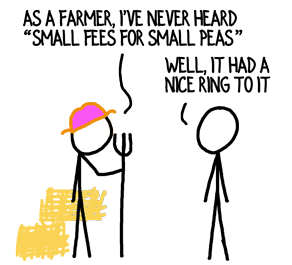
Small fees for small peas may work for farmers, but not for consultants.
Instead, your three good choices are:
- Walk away. You could politely brush off Phyllis, while congratulating yourself on remembering that small projects crowd out large projects.
- Fold it into a larger project. Educating Ms. Phinsternoodle on the benefits of a broader scope could pave the way to a more attractive, valuable engagement.
- Perform the project gratis. In the right circumstances, a few hours, days, weeks or even months of work “on the house” could pay out handsomely.
How to Make the Right Choice
To make sense of these choices and respond to opportunities correctly, you need to establish two standards for your consulting firm:
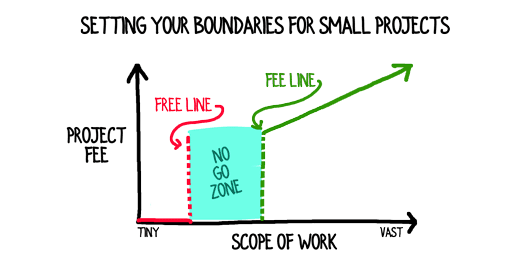
Free Line – Projects with scope below your Free Line are completed at no charge to your clients.
Fee Line – For projects with scope above your Fee Line, you charge an equitable fee.
Your Free Line and Fee Line are not adjacent. Between them is a No-Go Zone.
When you face an opportunity in the No-Go Zone, either walk away or fold it into a larger, paid project.
Why do any projects for free?
Because accepting tiny, for-fee projects diminishes the stature of your consulting firm and creates a precedent for clients to nickel-and-dime you.
A small effort for free shows you’re generous.
A small effort for a small fee shows you’re minor league.
Set different Free/Fee Lines based on the anticipated lifetime value (LTV) of the prospect.
Higher LTV prospects deserve higher Free/Fee Lines.
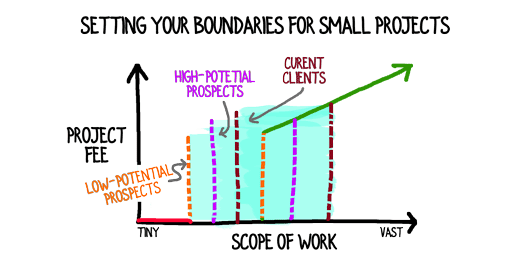
Current clients warrant the highest Free/Fee Lines.
A few days of work or even a couple of weeks may be a reasonable gesture if Phyllis generates $500k or $1 million or more in annual revenue for your consulting firm.
One caution with current clients: your Free Line applies to requests unrelated to your current initiatives. Requests for additional work on your existing projects are verboten. (That’s scope creep.)
How to Set Your Free Line and Fee Line
Your Free Line for prospects can be as low as you’d like—perhaps limited to only ten minutes of guidance.
Where you set the line is less important than having a line, knowing it, and sticking to it.
To determine your Fee Line, take the smallest engagement you’ve accepted over the past 18 months and double that number.
That’s your new Fee Line for prospective consulting clients.
In another 18 months you can double your Fee Line again.
What is your experience with accepting (or rejecting) tiny projects?

Text and images are © 2026 David A. Fields, all rights reserved.

I love this formula approach! In my own practice, I’ve always offered up to half a day of my time without charge to prospective clients – as long as they meet my own tests of being interesting, impactful and nice people.
This exposes me to new challenges as well as helping to build reputation – many don’t convert but that’s fine for me, happy to give a little something, especially to early-stage start-ups.
And some have become lovely loyal customers, and referred to to others as well. So that’s nice!
Excellent case study, Ben. Most small firms won’t give a half-day of consulting for free; however, if the prospect is strong enough and the eventual gain is high enough, offering that half day (or even more) could be worthwhile. One of our clients routinely gives 2-3 days of “free” work to prospective clients… and that’s how they consistently win seven-figure deals.
Thanks for sharing your approach, Ben. It will be eye-opening for many other readers.
David,
I stay focused on building a win-win relationship with my clients (which for me includes financial success) and I enjoy my work tremendously. Therefore it’s relatively easy for me to be generous with clients from time to time as long as it doesn’t undermine that long term goal.
Well said, Doc. Being tightfisted rarely wins friends or clients. Generosity, on the other hand, attracts valuable relationships. I’m glad you’re part of this community and generous with your thoughts, Doc!
I was literally just thinking about this issue this morning. Yes, I have taken on some low-fee projects, and you’re right, doing so results in large administrative, psychological, and opportunity costs.
Exactly, Gwen. Sometimes, especially when the pipeline is feeling thin, consultants take any project, no matter how small. Often, that reaction turns out to be counterproductive.
I really appreciate your sharing your experience, Gwen!
Its almost like you saw our recent gig, we ran a days workshop for a client gratis. We wanted to do it for them but didn’t want to set a precedent of small one day workshops here and there.
Well done, Fin! You’re setting a perfect example for other readers. I’m glad you shared your experience—it’s valuable for folks who might think they can’t give a one-day workshop away to realize that sometimes a freebie is better than a low fee.
Sorry looks like this reply ended up as a new comment, you can delete that one below…
We made very sure they understood that as a ‘project’ it was too small for us to package up, but we would do it as a ‘favour’. We’d facilitate the day for them as long as we kept prep and write up simple.
No idea if anything comes from it but it was a good day and met some good people, a very influential organisation in the UK media and news space so who knows, right?
Outstanding, Fin. Sounds like you communicated the situation well to your prospect. Maybe there will be a win in the short term or maybe it will be a win in the long-term. If you’ve built the relationships, you’re already ahead.
When I do webinars about Healthcare Data Analytics or QI Macros or Agile Lean Six Sigma, I always offer to help anyone with data analysis. Just send me an Excel file and I see what I can see, for free.
Few people ever take me up on it and yet they know I’m willing to help.
We don’t just sell software and how to use it, we sell solutions to get anyone past the frustration barrier of learning data analytics.
Nice one, Jay. As you said, by acting generously, you demonstrate that you’re dedicated to creating value for your clients (and your community). Wins all around.
Thanks for explaining your practice, Jay!