
 David A. Fields Consulting Group
 A grocer near my home prominently displays a sign proclaiming, “Rule #1: The customer is always right.”
That’d never work for consulting because, well, clients aren’t always right.
Rule #1 of successful consulting is: Consulting isn’t about you. It’s about THEM — your prospects and clients.
Got it. What’s Rule #2?
Let’s talk about rules for a moment.

Neil, my first boss in marketing, often stressed “The Freedom of a Tightly Written Strategy,” which means…
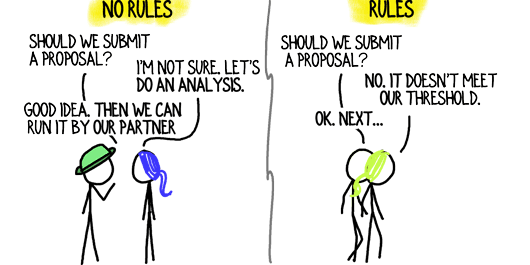
When you’re crystal clear about your target and the activities that will or won’t help the business, decision-making is easy.
(In hindsight, Neil may have meant, “Stop being so creative, David, and just do what you’re told.”)
A tightly written strategy implies rules.
Clear definitions of what’s in and what’s out.
That’s why rules are great. They direct your conduct, telling you what to do and what not to do.
A solid set of rules will save you time, boost your productivity, promote harmony in your consulting firm, and give your teenager an (additional) excuse to complain.
Rules can push you to delegate, deflect distractions, and dismiss bad consulting business.
Among the rules at my firm, for instance:
- We work only with advisory firms.
- We won’t recommend solutions we haven’t tried ourselves.
- Every client deserves some form of chocolate at the start of an engagement.
Rules are particularly effective if you’re trying to change certain behaviors or achieve a difficult goal.
For example, if you never seem to find time to reach out to prospects, you might decree, “No email in the morning before outreach.”
Rule #2: Develop a set of explicit (i.e., written) rules
More precisely, Rule #2 is to write the rules for each of the four underlying elements of your consulting firm: Strategy, Winning Engagements, Profitably Creating Value, and Infrastructure.
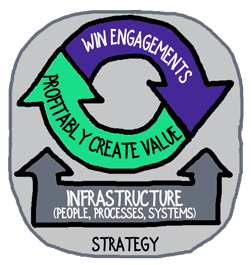
You can jumpstart your firm’s set of rules by looking at the examples below.
Strategy
Rules define who you work with, the problems you solve, and your consulting and financial models.
We work exclusively in financial services.
We won’t take on assignments shorter than four weeks.
Win Engagements
Rules govern your prospecting and specify the parameters of assignments you accept.
Don’t ever give a fee quote before completing a Context Discussion.
If we helped shape an RFP, we’ll bid. Otherwise, we won’t bid on an RFP.
Profitably Create Value
Rules encompass the client experience, productivity, delivery approach, and deliverable quality.
Voice of Customer reports must include at least 10 interviews.
Respond to client emails within one business day.
Infrastructure
Rules define how you run your business, including support systems, AI, how teammates interact, staffing assignments, and work/life balance.
Projects are staffed based on expertise, location, and YTD utilization, in that order.
Sending a question or request to a teammate on vacation is not okay.
What’s one important rule you follow to keep your consulting firm on track?

Text and images are © 2026 David A. Fields, all rights reserved.

David, Here’s a copy of the Linked In Post I wrote this morning: Partners That Trust
Today is different
Normally I don’t post in the morning like this.
In the lyrics of the song, The Gambler:
You got to know when to hold ‘em
Know when to fold ‘em
Know when to walk away
Know when to run…
It is time to walk away.
4 Times
I’ve only had to walk away from businesses I was key in four times in my life. Back in 1990, as the CEO of a thriving B2B Ad agency my board and I disagreed on the path of the agency to the future. I agreed to leave and founded Z-axis Marketing. So far, that has survived for 36 years. I stopped counting successful clients at 237. Along the way I became an international professional speaker and built two partnerships. The first ended when my partners husband died of a heart attack. We sold the second when both of us figured out that our passion was for our primary business. This time was different.
Agree to Disagree
Having lawyers for clients can be very instructive. They taught me that there are only a few rules to building a successful partnership. Here’s what you have to put into writing:
1. What each of you will do
2. How disagreements will be worked out even if you agree to disagree
3. How you will be compensated
4. How you will end it
I overlooked number 4 in this case. She decided to transfer the ownership of a Skool Group to me without discussing it. I did not accept the transfer. Now, all the people in that group are going to be wondering what happened.
The Takeaways:
• Partners that trust put it in writing.
• Partners that trust discuss, agree and then act
• Partners that trust end it amicably
Be Heard. Be Seen. Be Chosen
Jerry, your rule for a successful partnership is that four aspects of the partnership must be explicitly captured in writing. While I’m not sure all four actually must be written, it certainly helps to have discussed them.
Thanks for chiming in.