
 David A. Fields Consulting Group
There’s a phrase that will help your consulting firm close more, larger projects, faster.
You’ll use this phrase when you submit your consulting proposal (not in the proposal itself) and omitting this phrase is like forgetting to dip strawberries in chocolate—the oversight yields results that aren’t as reliably tasty or rewarding.
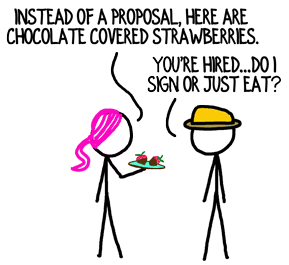
In all likelihood, your consulting firm’s proposals are good already. (Particularly if you’re using the Perfect Proposal Template.)
One way you’ve crafted powerful proposals is by always including a few alternatives.
You know offering alternatives continues the discovery process. It ferrets out insights about your client’s preferences, risk tolerances, and boundaries for your project.
In some instances, though, you may actually provide too many alternatives.
A smorgasbord of choices.
The smorgasbord appears when your client pushes you to unbundle your consulting offering into individual, separate components.
Or, you might be tempted to present a wide range of choices when the potential engagement scope has multiple variables (e.g., different individuals, groups, departments, divisions, service lines, geographies, etc.).
Alternatives are generally good, but there is a downside, especially as the number of choices climbs: choices add complexity to your client’s decision calculus.
Too many choices can slow down the decision-making process and reduce the likelihood of the client choosing any alternative.
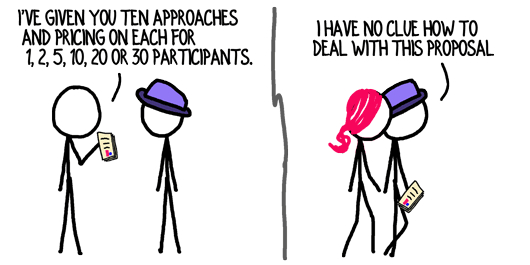
For some clients, even three choices can trigger indecision.
So, you need a few words that enhance the benefits of providing alternatives and mitigate the downsides.
That phrase you’re looking for is what I call an…
Empathic Recommendation
Any time you offer your consulting prospect alternatives, help them navigate the choices.
Remember, your clients are anxious and insecure about their decision to hire your consulting firm.
If engaging you turns out to be a poor choice, your client has wasted valuable resources and lost face.
Your guiding hand tamps down clients’ fears and accelerates the decision process.
How you couch your recommendation matters.
For instance, saying, “I think you should…” is an okay lead into your recommendation, but not great.
- It can sound like a self-serving recommendation of the alternative that’s best for your consulting firm.
- “Should” is a judgment word, and your clients don’t want to feel judged for seriously considering a different alternative.
- It highlights a gap between your thinking and your client’s thinking if he leans toward an alternative other than your recommendation.
The Empathic Recommendation is subtly different. It sounds like this:
“If I were in your shoes, I would…”
This particular phraseology reinforces that you’re acting in your client’s best interests.
It also lends a sense of social proof, which psychologically reinforces his decision if he agrees with your recommendation.
If your client favors an alternative other than your recommendation, he’ll feel like he hasn’t fully shared with you what being in his shoes is like.
That’s much better than him feeling like your consulting firm’s thinking isn’t aligned with his.
By always including an Empathic Recommendation, you increase the likelihood of winning a consulting project, you decrease the decision-making time, and you can guide your clients to select more valuable, richer alternatives.
What language do you use when you’re guiding your clients through choices in your proposals?
Text and images are © 2026 David A. Fields, all rights reserved.
