
 David A. Fields Consulting Group
 Jesper (actual name of the consultant) tried for ages to land a project with Astra Zeneca (actual name of client; a.k.a. AZ).
Jesper’s consulting firm had a history of work with AZ; however, they had only been able to win engagements in North America, not in Europe (actual names of continents).
Breaking news: after eight months of effort, Jesper closed a project with AZ Europe!
How?

Consultants like Jesper who are locking in new consulting projects are elevating their well-crafted BD process and careful language with one special hot fudge sauce:
Persistence
On the surface, this is as obvious as adding vanilla ice cream to hot apple pie.
Once you pick up your spork to dive in, however, you realize Persistence raises a couple of pesky questions:
- What, exactly, does being persistent entail for a consulting firm?
- Where’s the line between persistent and pest, and how do you stay on the right side?
Let’s grab a slice of Mom’s apple pie a la mode, and chew over answers to these questions.
What Being Persistent Entails for Consulting Firms
Generally speaking, persistence means:
1. Continuing to reach out to prospects until/unless they give you a flat-out “No.”
Many, many projects are won after a long period of silence or a series of Maybes.
2. Separating lack of response from your ego.
In other words, don’t take ghosting personally.
Executives are busy, absent-minded, distracted and stressed. If your project isn’t top on their list, that’s not a condemnation of you, it’s just a reality of their world.
Practically speaking, persistence means:
Reaching out to your prospect by email, Zoom, or direct messaging on a regular basis.
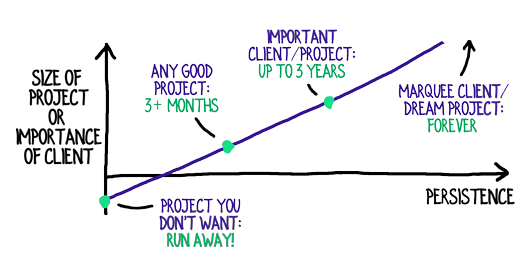
How frequently and diligently you follow up depends on the size of the project and importance of the client.
For example, AZ was an extremely important, strategic client for Jesper’s firm, so following up for eight—or even eighteen—months was a no-brainer.
Frustrating and discouraging at times, but worthwhile.
I have personally kept up regular outreach with prospects for almost a decade before they finally offer a juicy project.
How to Be Persistent Without Being a Pest
Consultants are often concerned they’ll be perceived as annoying if they follow up repeatedly with a prospect.
They fear becoming the professional equivalent of kids in the back seat during a road trip. (Are we there yet?)
That’s a legitimate fear, but also an avoidable concern.
There’s absolutely nothing wrong with repeatedly following up on an introduction or a project that’s under consideration.
In fact, busy, overwhelmed executives often appreciate the reminder.
Keep the following in mind:
- Focus on building the relationship rather than chasing the business.
- In your communication, acknowledge that your prospect is busy. In other words, let them save face and feel justified even though they haven’t been responsive to you.
- On the flip side, never make your prospects wrong. For instance, avoid mentioning the number of times you’ve previously followed up. That does nothing other than encourage a defensive posture.
- Ask how you can be of help to them in general and, specifically, in shaking loose the project.
- Keep your tone friendly, upbeat and light. An occasional dollop of humor can go a long way too. For instance, if the prospect has gone AWOL for months, you might try a “Did you get eaten by a bear?” type letter. This approach worked phenomenally well for one of Jesper’s colleagues.
- If you engage your prospect in conversation, encourage them to set specific times and action standards for deciding on your project. How, exactly, will they make the decision and when?
Have you found that persistence pays off?
How do YOU stay persistent without becoming a pest?

Text and images are © 2026 David A. Fields, all rights reserved.

Every Wednesday I find a David A. Fields email newsletter in my inbox. It feels like a warm blanket on a cold winter’s day. Thank you! Today’s reminder along with the 52 I have read consistently for a year guide and support me on this incredible journey.
Gosh, Molly, you’re incredibly kind. Thank you for your uplifting feedback today. ????❤️
Excellent and encouraging!
I found the following bullet point to be valuable in my pursuit of new business:
“Focus on building the relationship rather than chasing the business”…
the business will follow once they like you and trust you!
Exactly right, Frank. It’s particularly powerful hearing that affirmation from you since you’re well known to be an excellent rainmaker. I appreciate your adding your voice and reaction to the discussion.
I will just be transparent and say “I’m trying to be helpfully persistent but not a pest.” And then sometimes add, “So I won’t email you again about this.” More than a few times I’ll then hear back “I’m sorry, I’ve been busy, let’s find some time.”
Good add, Jonathan. Transparency and honesty are wonderful, aren’t they? If we’re brave enough to treat the folks on the other side as adults and to just share what’s on our mind, good things happen.
I very much appreciate you sharing your practice, Jonathan. It will be a huge help to other readers.
One of the key factors in successful follow up is frequency. Shooting one email/call/fax/etc. every 14 days seems to be a sweet spot. Every 14 days is frequent enough to stay top of mind and infrequent enough so you do NOT become a pest.
Jeromy, I’m not sure which is more interesting: your 14-day rule or that you still include faxes in your communication method! ????
Depending on the situation, 14 days can definitely be a good rule of thumb. In some cases–like the final stages of closing a project–weekly may be more appropriate. And if you don’t even have a project on the table, then every few months is a fair cadence. Your two-week rule is a solid starting point, Jeromy–thanks for sharing it!
Thanks for the inspiration, I just reached out to 3 former/potential clients with whom communication has been idle. For each I’d been worried about being “a pest;” however – and in keeping with Jeremy’s 14-day rule – I think I can rest easy that a relationship-first touch-base is acceptable.
Well done, Richard! Double bonus points for jumping into action (and inspiring other readers to take concrete steps too).
Please keep me apprised of how the persistence works for you.