
 David A. Fields Consulting Group
 Your consulting firm’s business development (BD) results will improve if you spread your efforts across a range of prospect types rather than focusing on just one.
The well-known Trail Mix Principle states that even though chocolate chips are the pinnacle of foods, it’s easier and more satisfying to eat a bucket of trail mix than a bucket of chocolate chips.*
The same principle applies to your consulting firm’s BD efforts:
Your consulting firm will generate the most satisfying and sustainable revenue if you cultivate a mix of current clients, past clients, influencers and new/unknown prospects.
Nice idea, but you could reasonably ask: what are the buckets of BD targets, how do you prioritize them, exactly how much time should you spend on each type of target, and how should you handle targets who don’t like coconut flakes?
Four Types of Targets
Current clients represent the first type of prospect because follow-on work is generally the easiest work to win.
A1s, the second type of target, are decision-makers with whom you possess a strong relationship. (The segmentation scheme is described in this book.)

A2s and B1s, a.k.a. the “Outer Core” are the third type. Pay particular attention to “strong A2s”—i.e., people who can introduce your consulting firm to many decision-makers.
Everyone else falls into the fourth type. These folks are “New Blood” because they either don’t know your consulting firm at all or you haven’t built a strong enough relationship with them to put them in your Network Core.
Prioritization
Prioritize your BD effort against each type of prospect based on the same Cascading Buckets approach used to create trail mix:
The Cascading Buckets approach fills each bucket, in order, until you exhaust your inventory of that type of ingredient/prospect or you reach the predefined limit for that type.
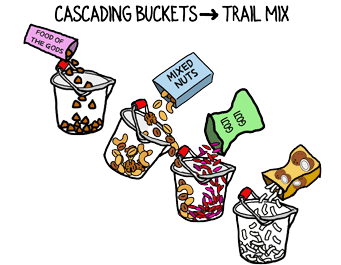
If your consulting firm only has two active clients, you’ll exhaust that bucket quickly.
With 50 current clients you’ll have to spread your A1 outreach over weeks or months to stay within that bucket’s time limit.
The specific limit on BD time/effort directed to each type of contact is:
- Current Clients: 25%
- A1s: 30%
- Outer Core: 25%
- New Blood: No limit
Exact Time Allocation
The rule of thumb for a consulting firm leader is to devote at least 20% of your time to business development. More is better, of course.
To illustrate, let’s say you’re very busy and can only devote a single, 10-hour day to BD each week.
Remember that BD includes visibility-building (a.k.a. marketing) and pursuit of specific engagements (a.k.a. sales).
- At most, you will spend 2.5 hours each week securing follow-on business.
- You’ll invest a maximum of 3 hours reaching out to and conversing with A1s.
- Up to 2.5 hours are devoted to improving relationships with B1s and gaining introductions through A2s.
- You’ll allocate all the remaining BD time—at least 2 hours—to B2s, A3s and attracting and meeting entirely new contacts.
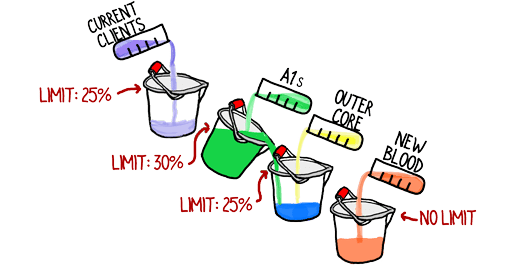
The Cascading Buckets approach is self-balancing.
For instance, the fewer high-likelihood prospects you have, the more you’ll focus on bringing in New Blood.
Of course, many of your consulting firm’s marketing activities touch more than one type of prospect.
That’s fine, as long as the full suite of your BD efforts cover all types of prospects, and you’re not concentrating all your visibility-building energy on existing clients or to general marketing.
Could this Trail Mix/Cascading Buckets approach help you organize your BD efforts?
Text and images are © 2026 David A. Fields, all rights reserved.

Nice guidance, David (and this tenet/metaphor “it’s easier and more satisfying to eat a bucket of trail mix than a bucket of chocolate chips” can be applied to many situations!)
Curious if and how your equation changes for the sole practitioner – thoughts?
Also: Does Randall Monroe of xkcd fame draw your comics, are you inspired by him, or is any similarity merely coincidence? (Or is he your alter ego (or vice versa)?)
Great question, Richard. Same ratios apply whether you’re running a solo practice or a large firm. Where it sometimes changes is for up-and-coming rainmakers at firms over, say, $10M–those folks can start with a lighter ratio of New Blood and focus more of that energy winning business from current clients.
Randall doesn’t draw the XKCD comics–he has an artist do them for him. I learned how to draw stick figures by looking at his site, then I reached out to him for permission to use the style in my published works. So, it’s definitely not coincidence–his site is the original and I’m a poor imitator!
Thanks again for asking the smart question, Richard.
Thanks for the response, David. And the insight into Randall’s process! (I’m also inspired by his work, especially the wry humor side of it.)
Yup, his work is fantastic. Not easy being a full-time “comic” even when you have staff to help. Much easier to be a serious person, like you or me, and inject occasion doses of
ryewry humor.A great article, David – very helpful!
Appreciate you posting your reaction, Alexey!
The Netwwork Core approach is pure gold. I recommend it to all my clients who view “sales” as a dirty word.
Yes, Matt, it’s very helpful to have a good handle on your Network Core and to build and nurture it. For consulting firms of all sizes, that’s the source of the vast majority of business. I appreciate you chiming in!