
 David A. Fields Consulting Group
 Winning consulting engagements is easy when your firm’s expertise centers on a burning, urgent need that your clients are desperate to address.
How do you identify the next, big consulting spend your clients will make? That’s easy to answer.
Let’s say you trip on a crack in the sidewalk and stumble into Reginald Rollydolly, CEO of Biertaysters, Inc. Holy cow! You’ve always wanted to work with Biertaysters.
Not only would they be a great client, they’re pretty typical of the industry your consulting firm serves.
If you could deduce the urgent, burning needs that will soak up Biertaysters’ consulting budgets the next couple of years, you could confidently position your consulting firm for growth.

After all, you know that sustaining and expanding a consulting firm is much easier when you’re Fishing Where the Fish Are; i.e., you’re offering a solution to a problem (or aspiration) prospects are painfully aware of and urgently want to solve. (For reference, see this book.)
You want to know your target industry’s emerging issues, strategic thrusts, and nascent challenges, right?
Wouldn’t it be amazing to have a crystal ball?
Sure. But it’s not needed.
You’re overcomplicating this.
My dad used to tell a story about the most accurate weatherman on TV back in the 1850s, or whenever it was my dad was a kid.
When the weatherman was pressed for his secret to forecasting he admitted, “I look outside the window, and whatever it looks like today is what I predict for tomorrow.”

In reality, that “persistence forecasting” technique is only about 35% accurate, especially in predicting precipitation.
On the other hand, the weatherman’s approach applies beautifully to your consulting business.
The Persistence Forecasting Effect in Consulting
- A business that has previously invested in addressing an issue is more likely than other prospects to seek consulting help on that same issue.
- A business that has previously engaged a consultant to work on an issue is very likely to hire a consultant in the future to address the issue again.
Net: if you want to know who will buy your consulting firm’s services, find out who has spent big dollars in the past to address the challenge your consulting firm is known for solving.
Similarly, if you want to know the next big consulting spend in your target market, assess what your target market has paid handsomely for over the past year or two.
Why?
The same reason that residents of Seattle perpetually need raingear, denizens of Buffalo need new snow shovels and homeowners in Venice need water pumps.
If you find Biertayster has spent $1 million on process improvement, I’ll bet you Biertayster is likely to spend another $1 million on the same thing over the next five years.
Who buys forecasting software? Those who bought it in the past.
Who wants consulting help with forecasting? Those who spend money on forecasting software and systems.
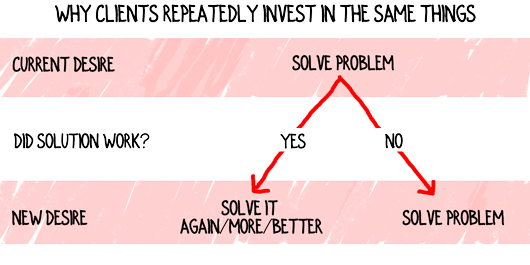
Persistence forecasting will suggest, with perhaps 35% accuracy, who to pursue and what to offer.
And that’s plenty accurate enough.
As consultants, we don’t have to precisely predict our prospects’ weather; we just need to offer umbrellas to the 35% of prospects who seem to always need them.
So, if you want to know the next big project your consulting firm could win, simply answer one question:
What challenge(s) do your clients have that they’ve already paid to solve?
Does your experience mirror what we’ve seen: clients ask for help on the same issues repeatedly?

Text and images are © 2026 David A. Fields, all rights reserved.

I wish I can say I have had a similar experience and opportunity. A colleague who is the CEO of a consulting engineering firm once shared that a few years ago their firm hired a consultant to improve their operations. At the end of the task, the client concluded that the consultant provided no new insights. In fact, I recall the CEO citing the consultant and wrist watch anecdote. Perhaps at my next meeting I will follow up with a few open-ended questions to learn about (and learn from) that situation.
Joe, what you encountered is all too common. There are many, many executives who are understandably wary and skeptical of consulting firms because they’ve squandered money on consulting projects that yielded no results. Typically, a fair portion of their disappointment is warranted. (And, if those clients were required to be honest, a fair portion of their disappointment would be directed at their own actions and expectations.)
As a result, many prior purchasers of consulting are slow to purchase again. However, even once-burned prospects are often better targets than executives who have never once hired consultant. Distrustful decision-makers need to be heard and reassured. That’s what relationship-building, discovery, and consulting (vs. pitching) are all about.
I’m glad you shared your experience, Joe, and created the opportunity for this additional exploration!
“Obtuse Associates – tackling your acute problems” 😉
Always priced at $180k for our Triangulation Diagnostic. (ok, enough geo-kes now)
Bonus brownie points for your contributions. (And I’m sure other readers appreciate your angle.)
That’s a good one, Franziska!
This is aligned with my experience. Some companies work with consultants so routinely and it’s as though it’s part of their DNA. The only downside for newcomers is that these companies usually have strong preferences for who they work with. (Eg the incumbent). That’s great if you’re in but I wish there was an easier way to identify the need and position as an alternative to the incumbent
Great point, Steven. Sometimes the need for a change is obvious because the original work didn’t click. However, even if the client is happy with their incumbent’s work, there may still be an opportunity to wedge an opening for your firm with a simple question:
“When you think of the previous time you engaged XYZ to work with you on this issue, was the project a 10 out of 10, and, if not, what would have made it a 10 out of 10 or (jokingly), an 11 out of 10 for you?”
Let me know how that works for you, Steven.
Love it! Great strategic and tactical advice. Thank you David
Cool beans. That’s why we’re here!