
 David A. Fields Consulting Group
 As a consulting firm leader, you’re constantly wrestling with the clock.
You and any consultants on your team need to balance project delivery, business development, internal projects and administrivia.
Oh, and a minute here or there for family time would be nice.
Aaaack!

There’s a simple fix that will probably open up at least a couple of hours every week:
Stop over-delivering.
Most consulting firms orient their delivery around delighting their clients, then ask this question:
“What can we do that will delight our client?”
This is a sufficiency mindset.
Sufficiency reacts to the hope that delivering more will create a happier consulting client.
But there’s no end to how much you can deliver to create delight.
Hence, a sufficiency mindset begets self-imposed scope creep.

Orient your consulting firm around a different question:
“What is absolutely necessary to delight our client?”
That’s a necessity mindset, and every item you list in your answer to that question must be challenged by this second, follow-up question:
“Is it possible our client could be delighted if we don’t complete <line item>?”
Complete only the tasks necessary to create delight. None of the other tasks, even though you’re aching to.
You’ll crank through your consulting projects in a fraction of the time.
You’ll also have happier, more-delighted consulting clients.
Wait… What?!
Won’t cutting back on your over-the-top delivery reduce client delight?
No.
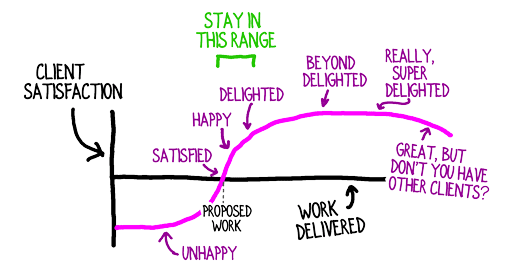
Over-delivering means you’ve done more than required to delight your clients.
Keep this important fact in mind:
Other consulting firms aren’t over-delivering, yet their clients love them too. (Really, they do.)
Your clients value simplicity and focus.
Clients usually prefer an elegantly simple solution delivered in four weeks to an overstuffed approach that requires four months.
Have you ever delivered less and, as a result, saved time and delighted your client more?

Text and images are © 2026 David A. Fields, all rights reserved.

I think it’s about over-delivering in a smart way. Go for the over delivery of stuff that has a high appeal and not much effort (assuming you won’t charge for it). Swiss Airlines gives a small bar of chocolate to everyone on every flight. It’s a small over-delivery gesture that delights and reminds customers how ‘great’ Swiss is.
Of course, it also depends on the risk/reward profile. We just over-delivered on a small (first) project for a large client, and now are talking about much larger follow-on projects. Over-delivery made sense in this case.
You’re absolutely right on both points, Ian. A small amount of over-delivery can quickly move client satisfaction from Happy to Delighted. It’s the challenging, labor-intensive over-delivery past that point that can become a problem.
Also, to a point, if you’re working on a proof-of-value project or a pilot, you want to ensure that you’re creating an outstanding client experience that will open the door to the larger engagement. The watchout is creating an expectation of over-delivery. When that happens, you end up working beyond scope just to satisfy the client.
Great additions to the discussion, Ian!
Bonus points for the chocolate reference, Ian!
Funny. And right on, Franziska. Inclusion of chocolate always merits bonus points!
Thanks, David,
I’m always thinking of ways to develop the “value-add,” and I have learned this lesson in the past. That said, for “people pleasers,” or those of us with a “servant’s heart,” we must be vigilant on what we’re providing and what’s expected.
That last line I wrote reminded me of another point: if you wanted to expand the conversation.
By constantly over-delivering for a repeat or long-term client, you could set yourself up by adjusting the client’s expectations that you will always give more than the scope provides. Then you are on the road to disappointing the client.
That’s exactly right, Don, and similar to what I pointed out in response to Ian’s comment. When your over-delivery becomes the baseline, you’re setting yourself up for dissatisfied clients and an unprofitable business. As you point out, vigilance is the watchword.
Thanks for adding your valuable thinking to the discussion, Don!
This is a fantastic framework, David. In my past Corporate life, I went through many executive assessments that came out and said that “responsibility” is one of our primary points of strength. Great – I thought! The flip side of that strength is the mental urge to “do more” and “more” – to delight your stakeholders. You open my mind to the idea that I have may have pushed too far right into that flat part of your client satisfaction curve. I’ll now try to be more mentally conscious of this – thank YOU!
Well said, Shankar. Balance the sense that you’re responsible for creating success with the understanding that others bear responsibility too. Plus, you want to make sure they have the opportunity to create value–don’t hoard all that value-creation! ????
I’m glad you jumped into the conversation, Shankar.
I try to stay in scope of the project contracted which is what we agreed on. But that doesn’t mean I don’t have little value-added things in place, like weekly follow-up emails with clients on open projects, I am a solo-preneur, so they usually get to talk with me, the big gal. I send clients Christmas cards every year, currently that is about 350-400 clients give or take that I have mailing addresses for. And boy they think that’s great. 🙂 We can over delivery in different way not related directly to the project :). Someday I’ll tell you about the horrors of cards with glitter. The office sparkled for years!
Talking with the big gal! Way to go, Elaine. The little things often matter most, so you’re approaching value creation in exactly the right way.
Thanks for sharing your experience, Elaine.
We used to over-deliver by taking on as many small tasks as possible, along with solving big hairy problems. The pitch went something like this: “Sure, we’ll build out your finance operations, but while we are at it, we’ll also manage your bookkeeping, tax filings and keep tabs on those delinquent clients.”
When we managed to do all of the above, clients were delighted. The problem was that my team wasn’t and we were poorer for it.
In speaking with clients, we realized that the real value-add, in our clients’ eyes, was solving the hard problems we were uniquely positioned to solve. Throwing in all these other tiny tasks was a nice bonus but not a determining factor of their satisfaction with our work.
One client put it to me this way: “When I take my 7-year-old daughter to her favourite gelateria, she always eats first the cookie they stick on her gelato. When I asked her if she loves the cookie, she said ‘It’s okay, I just want to get it out of the way to get to the good part’ – the gelato itself.”
Outstanding case study, Vic. And double gold bonus points for the gelato AND cookie example. Your daughter knows a thing or two about what’s important!
Good on you for speaking to your client to find out what’s valuable rather than assuming you know. That practice is the missing link for many consultants (including many readers who are now jotting down, “Ask clients what they value!”
I very much appreciate your contributing your case study to the conversation, Vic.