
 David A. Fields Consulting Group
 If you want to ratchet up the revenue that flows into your consulting firm and the profits that land in your pocket, you need to increase your value to clients.
The 3D model below will help you expand the value of your firm’s services, the fees you command and the margins you enjoy.
The 3D Model of Consulting Value
Degree
Degree answers the question, “How far can your consulting firm move the needle?” on the issue you address for your clients.
For instance, if you increase sales, can you heighten sales results even further?
If you cut costs, can you slash more aggressively?
If you boost morale, will participants in your projects skip down the halls humming merry tunes?
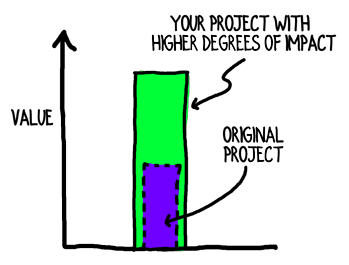
Adding to the Degree of Impact isn’t always easy.
When clients view results as binary—success is either achieved or not—they won’t value your consulting firm’s ability to create “even more” results, and the client may award the project to a low-fee competitor.
On the flip side, your consulting firm’s ability to affect the degree of impact is a perfect setup for offering alternative approaches with varied scope and fees to your clients.
Depending on what approach (and fee) appeals most to your clients, you can win the low-fee project while still maintaining your margin, or win the high-fee, high-impact engagement.
How can you increase the Degree of Impact your projects create for clients?
Diffusion
Diffusion is the art of bringing additional dimensions of value into play in your current projects.
If you increase operational efficiency, could your engagements also reduce employee attrition or increase customer retention?
If you successfully rebrand the client, could your projects also open the door for innovation?
If you improve meeting efficiency, could every lunch meeting include pizza? (I’d sign up for that one.)
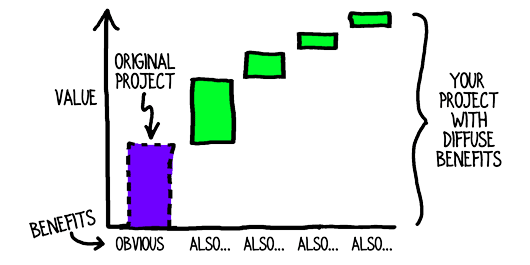
To leverage Diffusion as a value-enhancer, your client must recognize and truly appreciate the results you can create on additional dimensions.
How can you widen the aperture on the value your consulting firm creates for clients?
Duration
Duration embodies the longevity of your results.
If you teach negotiation skills, can the concepts be embedded in a system that lasts years after your project concludes?
If you bolster leadership, can you create rituals that ensure the client doesn’t revert to their old, unhelpful behaviors?
If you’re updating an IT system, can you ensure it’s future-proof for at least, say, three months? (Seems daring, but could be possible.????)
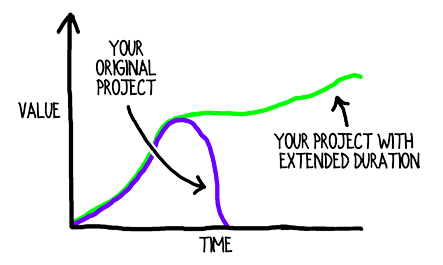
Winning on Duration requires you to think beyond the immediate win and, importantly, to extend your prospect’s vision into the long-term as well.
How can you make your results stickier and longer-lasting?
Degree, Diffusion and Duration are all legitimate paths for building your average project size.
Which of the three dimenstions works best for expanding the value of projects at your consulting firm?

Text and images are © 2026 David A. Fields, all rights reserved.

Great stuff!
Have you sometimes experienced this: You may propose the extra value and, at first, they want to stick with the original project. But, after they see the results they are getting, they might be please enough to then ask you to do the other things from your proposal?
Absolutely, Praveen. If your application of the 3Ds translate into new or different activities (which is almost always the case for Duration), you could built those into your proposed alternatives, then the client may choose to take the higher value, higher fee parts of your proposal later.
I appreciate the great follow-on question, Praveen.
Brilliant stuff, David! Rethinking my marketing plans for next year and this hit me in the side of the head: the biggest opportunities I’m going to have next year are including these sorts of ideas into every proposal. Thanks. No, thanks again.
Woot! Your plan to bake the 3Ds into every proposal is inspiring, Belden. Definitely keep me apprised of your wins.
David, great article, and you described it very well.
Our ERP replacement consulting proposals typically include several options, some of which are preselected, while others are not. If the client pushes on price, they can uncheck some options.
Our projects are “fixed fee”. There is a 40% upfront fee paid over 4 months and a 7.5% retainer. We assume the project will be completed within 8 months. If it takes less, they save a little retainer. If they take longer (usually due to client delays), they pay a little extra.
On the other hand, if they like the project and our approach, they ask if they can accept some of those options, which corresponds to the diffuse options in your article. When this happens, we adjust the project so the client’s fees are the same as if they had initially accepted those options, which means a lump sum payment adjustment and an increase to the retainer. For our consulting business, where projects are well-defined, this approach works very well.
Great example, Chris. You have a sophisticated proposal approach and it creates a lot of optionality for you and your clients.
Just for clarity (for you and other readers): Diffusion does not necessarily require doing more or different work. Diffusion is a value-recognition approach. What are the other ways your current work creates value that, perhaps, you and your clients are overlooking? If you tap into that additional value, your clients desire and willingness to pay will both increase.
Thanks for sharing the excellent case study, Chris.