
 David A. Fields Consulting Group
 True or false: In consulting, if you want to earn big, you need to think big.
That’s true.
True or false: In consulting, if you want large projects you need to work with large clients.
Surprisingly, that’s false.

Rather than thinking about the size of your clients, become obsessed with the relative value your consulting firm produces for your clients.
Restated in more visceral terms:
If you’re picturing a chocolate bar, you get a chocolate bar… even if your client is a megalithic chocolate factory.
When your gustatory imagination conjures up chocolate rivers, you could end up swimming in Willy Wonka’s kingdom.
A True Story About Big and Small Clients
Consultants who focus on small clients often point out that small clients tote around small purses.
And, those consultants proclaim, small purses can’t accommodate big, juicy, lucrative, value-laden projects.
That used to be my thinking too.
In fact, when I built my consulting firm 20+ years ago, I specifically targeted $1B+ manufacturers.
The Willie Sutton logic of “that’s where the money is” was undeniable.

But a funny thing happened on the way to the cash register.
A $25M company became a client and, to my delighted surprise, they signed six-figure projects with us year after year after year until we stopped serving corporate clients.
Was this an anomaly or did I need a mindset shift?
Mindset shift.
After winning sizeable projects from the $25M client, I then won six-figure projects from $10M businesses, then $5M businesses, then even businesses whose annual revenues were under $1M!
Holy rethink-my-assumptions, Batman!
Implications for Your Consulting Firm
If small companies will sign substantial projects, just consider what that opens up for your consulting firm.
- Small companies—say, those under $25 million—outnumber large, $1+ billion companies by a factor of 6.25 bazillion-to-1. (Fine, the actual statistic is about 2,500-to-1).
- The decision-maker in a small company is often far easier to reach.
- The competition from brand-name firms and embedded incumbents is often far lower.
BUT, if a company is so small, will they pony up for a sizable project?
As a friend of Nemo (the fish, not the captain) said, “That’s a pretty big but!”
The answer: Yes.
Every $10 million company is wrestling with at least one million-dollar problem.
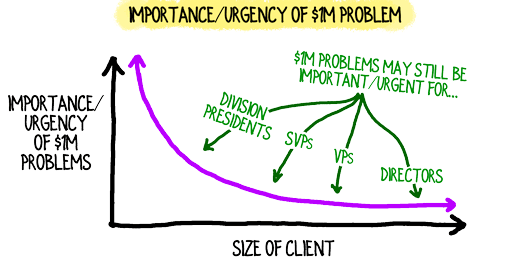
Most are plagued with even larger problems (e.g., how do we double to $20 million without breaking?)
Those million-dollar problems support six-figure projects. Voilà.
Yes, larger companies include many, many large issues on their to-do lists; however, the urgency driving each one is lower, and the internal staff available to tackle those problems is greater.
At the small company, the million-dollar issue is the priority.
It’s a fresh, dark, chocolate river of opportunity waiting for your firm to dive into.
Also, even if you create $100M in value for a huge company, they won’t pay your consulting firm $10M. They may not even pay you $1M.
The ratio of financial and qualitative reward to value created is often much higher when you work with small clients.
The Intersection Between Small Clients and Your Consulting Firm
You may still be hesitating, thinking, “My consulting firm doesn’t work on those big, juicy, million-dollar problems.”
Well, my friend, why not? What’s stopping you?
Absolutely nothing.
Small companies in every industry and every market are facing myriad, major challenges.
Your mission is to be open-minded enough to listen for the opportunities and then imagine how your firm’s capabilities could solve those major challenges.
Easy? Perhaps not.
Possible? Absolutely!
What has your experience been with small clients?

Text and images are © 2026 David A. Fields, all rights reserved.

I’ve found that smaller mid-sized firms are underserved. They offer tremendous opportunity for me to have significant impact.
Excellent feedback, Tara. That portion of the firm-size spectrum is still considered too small for large firms to target or to serve with their best talent, which leaves those businesses wide open for small consultancies. (To be clear, I think all businesses are in play for small consultancies.)
I’m glad you shared your experience, Tara. It serves as a good case study for other readers.
Hi David,
I moved from big company to smaller company clients many years ago so I could work locally more, travel less, and not miss my children growing up. I also realized I could make enough money with this model to be very happy. Voila! However, you’ve given me food for thought about whether I’m charging enough for the value I’m delivering. Thank you sir!
Exactly, Doc. just because a client is small, doesn’t mean your fees should scale down commensurately. (On the flip side, they also don’t scale up commensurately. A $10Bn firm won’t pay you $10M for your work.)
Hmmm… maybe it’s worth writing an article (or an illustration) on pricing vs. size of client. Thank you for that feedback and inspiration, Doc!
Thank you, that would be a very helpful article to read – we work with big and small clients – some are corporate, some are more entrepreneurial. However the amount of time we spend with smaller clients, is often more time intensive and because we charge a project fee rather than a daily rate, we are not charging them more for our time. We often find that smaller clients need more hand holding and educating (even thought they often think they don’t) whereas working with larger companies isn’t at time intensive. It would be interesting to hear your thoughts on how to manage this.
You’ve brought up an interesting question, Janet, which I’ll add to the queue for our Monday live Q&A. (https://davidafields.com/mondaylive) Good on you for conducting client-level and/or project-level margin analysis.
Many consultancies find the opposite–that the bureaucracy and decision-making processes at large clients are so bloated that the work with those clients is inefficient. Either way, though, if you find a certain class of client or project is lower-margin then you can: fine-tune your delivery model for those situations, change your offering, raise your fees, choose not to take on that type of work/client, or absorb it as part of your overall revenue mix.
Thanks for creating the opportunity for a deeper discussion, Janet!
I’ve found that most big businesses can no longer solve problems as effectively as they could when they were smaller, in part because the embiggening eventually gets you to a place where effective solutions take much more time and are much riskier. For example, a giant business has maneuvered itself into a space where it has to sell to anyone with money, not just its best customers, and this cuts off a lot of practical, effective solutions. I’ve found that smaller companies nearly always need to find more of their best customers, and so that’s where I’ve chosen to focus. It’s lovely in lots of ways.
Your experience is a great case study, Troy. (Also an interesting contrast in perspectives on big businesses vs. Janet’s comment.)
As you’ve pointed out, there are many reasons small companies need help, will value your services and and be rewarding to work with–and that doesn’t necessitate small projects with low fees.
Thanks for jumping into the conversation, Troy!
Really interesting perspective. It’s pushing me to think about the trade-offs differently. Doc’s point about smaller clients often needing more hand-holding is true in my experience, but David, your point about less bureaucracy at smaller clients is too. What I’ve seen is that expectations management in the first couple weeks makes the biggest difference. When I’ve laid out progress once or twice a day (especially early on), what’s done, what’s next, it’s made things smoother
Well said, Steven. If you find a certain type of client has particular needs, then you can adjust your delivery approach to accommodate those needs (and, perhaps, improve your delivery and value) while minimizing the cost to you.
Excellent addition to the discussion, Steven.
Great article David. I’m doing coaching and teamwork right now for a company that is literally two people. The team work is with a joint venture they are doing with 5-6 other companies. Apart from the money, which is fine, I really can see where I’m helping both the person I’m coaching and their success.
The immediate impact when you work with a small client can be huge and inspiring. And, as you said, the money is “fine.” Good on you, Jonathan!
I appreciate your sharing your case study–if you can get great work with a two-person company, imagine all the opportunity out there.