
 David A. Fields Consulting Group
 Your consulting firm is chock full of problem solvers, synthesizers, and connect-the-dotters.
Yep, you’re a bastion of cerebral smarty-pants, and your firm uses its mega-intellect to set your clients on the path to success.
Sure, some clients toss around scientific terms like petabyte, zetabyte and yottabyte while you fall back on gibberish like GenAI enablement, operational resilience, and incentive architecture.
But your team knows how to incentive architect a yottabyte.
(Or, at least you can say they can and punctuate your command of the topic with a 2×2 matrix.)
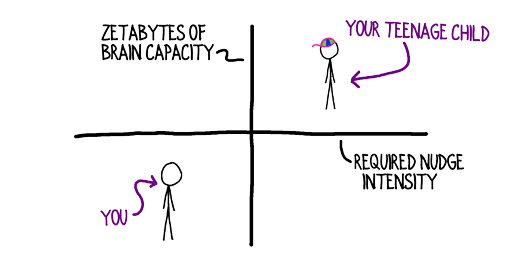
Your consulting firm’s talent is mostly above the neck. Big heads stuffed with intellectual property, intellectual capital and intellectual know-how.
And that’s a problem.
You’re expecting your prospective consulting clients to see the obvious advantages your firm presents because you’ve tapped your consulting firm’s brainpower to propose great ideas.
However, the folks you’re talking to are listening with their viscera, not their cerebra.
They don’t even hear you.
If you talk more about the hard benefits your firm delivers to your clients’ organization than the soft benefits you create for the individual, then you’re probably not closing as much consulting business as you could.
Hard benefits speak to your clients’ Needs. Soft benefits speak to their Wants.
When it comes to closing projects, Want makes all the difference.

How do you address Want?
First, your consulting firm will achieve faster, more consistent results by focusing on pain than by focusing on gain. (Sorry. I know you prefer to focus on gains.)
Pain is a much more powerful motivator than gain. Gain is great, but it’s often discretionary.
To understand your consulting prospect’s Wants requires personal knowledge.
Knowledge you gather when you build a genuine relationship with your prospect.
(Knowledge you’re devoid of if you’re just trying to sell to prospects.)
When you have strong relationships with your prospects,
you learn about them on the emotional level.
Deep relationships gift you insight into what’s injecting happiness into your prospects’ lives, and what’s sapping away vitality like a joy-sucking super-mosquito.
With that emotional knowledge in hand, you can offer affective information.
For instance, comparisons to benchmarks or competition (comparisons are inherently emotional), or the personal consequences of not taking the action you recommend.
Of course, your knowledge of your contacts’ emotional drivers is a fragile gift that you should safeguard jealously.
Never use your personal insight to manipulate or take advantage of another person.
The bottom line is this: reexamine your marketing collateral, your discovery process (your Context Discussions), your proposals, and your negotiation approaches through an emotional lens.
Are you stressing intellectual arguments or emotional wins?
How could you dial up the Want in your communication?
I’m curious about your experience:
Did emotion, logic, or both drive your biggest consulting sale so far?

Text and images are © 2026 David A. Fields, all rights reserved.

Hi David,
Good stuff! Zig Ziglar said that people buy on emoition and justify with logic, and I’ve found that to be true. The main purpose of solid rational thinking is to manage our emotions well so we’ll feel good now and be optimistic about feeling good in the future (my definition of happiness). What could be more important to the folks we’re trying to help?
That Zig fellow new a thing or two, right Doc? Yup, it’s an emotion-driven game we’re playing.
Thanks, as always, for adding your two cents to the discussion.
Hi David, During my consulting career I quickly learned to concentrate on having the client talk about the issues they were trying to deal with or improve. This was much more important to them than listening to all the wonderful services we could provide. Once I understood the client’s problems being able to mention how we had helped other companies address similar problems seemed key to convincing the client that we could be the potential solution they were looking for.
You’ve hit two central tenets to successful Business Development, Roger: 1) Right-Side Up. It’s all about THEM (not you). 2) Clients want a firm that has experience solving the exact problem they have for other businesses exactly like theirs. That’s why focusing on a niche is so powerful.
I’m glad you added your helpful perspective, Roger!