
 David A. Fields Consulting Group
 What makes a consulting firm exceptional?
Yes, weekly tiramisu deliveries for everyone on the team.
And what else makes a consulting firm exceptional?
Outstanding clients.
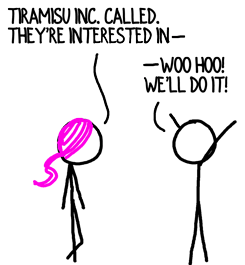
Selecting your clients carefully is essential for your consulting firm to grow and provide the rewards you’re looking for.
Working with terrific consulting clients sets the stage for cheerier days, happier staff, and a more lucrative practice.
It also magnifies your firm’s ability to win additional excellent clients, because:
- Delighted clients rave about your services to other prospective consulting clients;
- Successful outcomes spawn compelling case studies you can present to prospects;
- Exciting, fun partnerships perk up everyone in your group, and prospects are more likely to work with an upbeat firm.
Your consulting firm should have a Go/No-Go checklist and scoring rubric for consulting prospects.
Bust out your rubric when you’re actively identifying targets for your firm, when your relationship-nurturing activities reveal a consulting opportunity, and on those happy occasions when a consulting prospect appears out of the blue.
We’ve talked about prospects to avoid, but what goes on your consulting firm’s checklist for identifying a first-rate client?
10 Signs of a Great Consulting Client
Within Reach
Being able to enter into conversation with the decision-maker is the #1 attribute of your ideal consulting prospect.
Reachability is critical when you’re defining specific targets for your marketing.
Even when consulting prospects magically appear at your doorstep, ongoing, easy access to the decision-maker is a crucial ingredient for the consulting engagement to succeed.
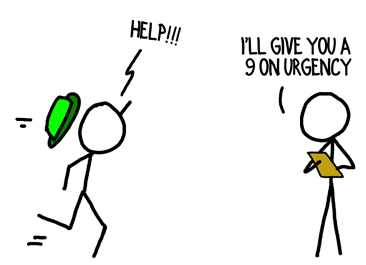
Displaying Urgency
Your best consulting clients exhibit a burning desire to make progress.
This manifests as quick decision-making and short timetables.
For instance, you want a consulting prospect who sets the date for your follow-up conversation within days, rather than weeks.
Likely to Succeed
Stack the deck in your favor by accepting only consulting clients whose outcomes are likely to be favorable.
When you compare past consulting projects that succeeded against any that yielded poor outcomes, what were the differences in your clients’ situations, behaviors, attitudes and approaches?
Use those differences to winnow out likely losers and select future winners.
Sufficiently Bankrolled
Great consulting clients have large problems and the budget authority to solve them.
You’re not always looking for the highest-level people in the biggest companies.
That said, the size of your prospect’s purse is generally a function of the size of the outcome they’re seeking and their position within their organization.
Clear on the Decision-Making Process
Ideally, your prospect has a single well-defined decision-maker for your consulting project.
At the very least, the decision process and criteria should be unambiguous.

Not Run by Procurement
Ideally, your conversations are directly with the individual who is struggling with the issue your consulting firm specializes in addressing, not with a procurement manager.
RFPs are a significant channel for some consulting firms; however, they’re typically not the calling card of wonderful clients.
Trustworthy
Integrity is foundational in your consulting firm, and it’s just as important in your clients.
Your anxiety lessens and your workdays brighten when you trust your clients to stand by their decisions and pay you promptly.
This is particularly vital if you enter into risk-sharing consulting contracts.
Candid
Similar to trustworthiness, candor is a prize attribute in consulting clients.
Your consulting firm’s delivery is infinitely easier and more likely to succeed when your client is open and honest about their woes, concerns, internal politics, past successes, and anything else that can affect the process.
By the way, candid clients also are quick to point out when they’re not happy with you or your firm’s work.
Candid feedback allows you to rapidly adjust, achieve success, and improve your consulting firm’s offering.
Outcome Focused
Sterling consulting prospects are obsessed with the value of achieving their outcome.
By definition, this means the cost of your consulting engagement is not driving their purchase decision, as long as you’re providing a solid return.
? _________
A few other important attributes on my firm’s Go/No-Go list aren’t in this article because I want to hear from you too.
It’s time for you to build your Go/No-Go rubric if you don’t have one.
What else do you think signals a good prospect for your consulting firm?

Text and images are © 2026 David A. Fields, all rights reserved.

Great list. In the nonprofit world, where I work, the “within reach” category would also include that there’s a single point of contact and single decision maker. If it’s a board member who reaches out to me, there’s a strong probability that they’re not going to line up on several of the other criteria on your list. Boards can be very slow and working with them can be like herding cats. The engagement can end up being equally difficult.
Not always, but often.
Excellent point, Sean. While it’s rarely the case that a decision is made by committee (even on Boards, for any given decision there’s a clear leader to whom the others defer), it’s much more challenging to win business in those situations where there’s no clear decision-maker.
I appreciate your adding to the list, Sean!
I would add that they have a commitment to do the work. It’s not all on you as the consultant, and they need to do their part. You can usually gauge the level of their commitment while they are still prospects.
Well said, Tina. You’re 100% right that the client has to be in the boat pulling with you. Thank you for adding that to the list.