
 David A. Fields Consulting Group
 Lost a Consulting Opportunity? What Really Went Wrong
You’d love to boast of 100% close rates—clients accept every proposal your consulting firm submits.
Alas, you and I both know that some great consulting opportunities have slipped away.
Think about a recent project that didn’t come through for your consulting firm. Let’s call it Project X.
Did your consulting firm do something wrong?
Quite possibly.
Then again, possibly not.
Understanding prospective clients is a bit like contemplating the walls of Bryce Canyon at night with a flashlight.
Some geologic layers flash an iridescent response to your light; other strata remain stubbornly dark and unresponsive.
That has a little to do with your light, and is mostly the result of the composition of each rock layer.
Similarly, each prospect’s reaction to your business development process reflects that particular organization’s makeup.
The approach that resonates deeply with one executive may sound like fingernails on a chalkboard to another consulting prospect.
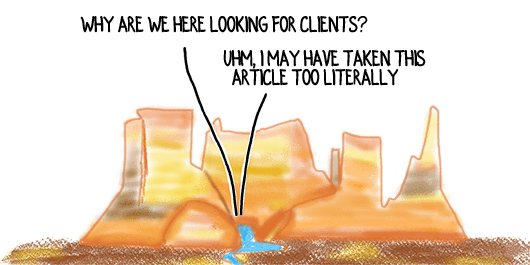
Occasionally you can—and should—stave off your introspective angst by realizing it has nothing to do with you and everything to do with your prospects’ history and environment.
On the other hand, if your process for winning clients shows consistent weaknesses, investing in a better business development approach is worthwhile.
But I digress. Let’s get back to the sad fate of Project X.
We need to know why you lost that engagement so that we can win more projects in the future.
Was it a weakness in your selling process and capabilities, or did some unmanageable feature of your prospect torpedo the opportunity?
Below are two sets of post-loss diagnostic questions. Based on your answers, you can correctly decide whether to improve your business development prowess or to walk away from a lost project with nary a regret.
10 Post-Loss Diagnostic Questions
Was Your Business Development Process Solid?
- Were you dealing with the decision maker?
- Did you say something that triggered resistance or caused your prospect to disengage?
- Did you conduct a full Context Discussion, walking through all six parts?
- Did you compellingly articulate the value of hiring your consulting firm versus other alternatives (e.g., other firms, internal staff, or doing nothing)?
- Did you manage objections well, including any fee objections?
If you answered “No” to any of those diagnostic questions, invest in boosting your business development capabilities.
Was It About Them, Not You?
- Did your prospect ask for your firm’s help to address a passing nuisance rather than a meaningful, urgent challenge?
- Did your prospect profess any inherent bias against consultants in general?
- Did your project fall victim to internal politics, project blockers (such as legal) and/or competing forces?
- Did your prospect employ a rigidly simplistic approach such as an arm’s length RFP?
- Were your prospect’s expectations about the cost of consulting unrealistic?
If you answered “Yes” to any of those diagnostic questions, improve your opportunity-qualification process; beyond that, put the loss behind you.
What else should you ask yourself to determine whether a project that didn’t close was the result of your process or the prospect?

Text and images are © 2026 David A. Fields, all rights reserved.

I just had a discussion with a perspective client and we could not get the urgency. They openly admitted if they did nothing they would be fine. I think that is still a miss on my capabilities. Is the Context Discussion in the book?? I can’t remember.
Tony, lack of Want (i.e., no urgency) is the most common cause of prospects ghosting you after you’ve discussed a project. Yes, the Context Discussion is laid out in detail in The Irresistible Consultant’s Guide to Winning Clients. (It’s also outlined in The Executive’s Guide to Consultants)
David,
Great article on knowing what you can control and what you can’t. Makes me think of a couple of my favorite quotes: 1) “For true peace of mind, resign as Master of the Universe.” 2) “When all else fails, lower your standards (from ‘perfect’ to ‘excellent’).”
All the best.
Those are two excellent quotes, Doc. Words of wisdom worth living by. Thank you for contributing them.
I would add, to the “it’s them, not me,” category that sometimes the prospect already has a preferred vendor but they have to get a minimum number of bids before they can move forward. So getting a proposal from me is just them checking a box.
My experience is that this happens more often when they find me through an internet search rather than coming to me through a referral.
Very good perspective, Sean. You’re right that sometimes–especially if you’re being asked to apply to an RFP–you’re “cannon fodder” for the project. Thanks for bringing up that point.
Agree with both points above realizing there tends to be noise in the channel. I have collected many lessons from past project teams, but I have learned what one client loves another client sees as “does not apply here.” So do your best with all the assessment points above but realize each client is different (different culture, different history, different priorities, etc.) and adjust as best as possible. Remember you want to be with a client who wants you. When your proposal is not accepted, leave them something of value, plant a seed. You never know what the future holds.
Excellent perspective, Lon. Ideally, we build long-term relationships with clients that are enjoyable and value-added on both sides. Sometimes, if a client turns you down it’s a blessing in disguise because that wasn’t a client with whom you’d want a long-term relationship.
Thanks for contributing your wisdom, Lon.