
 David A. Fields Consulting Group
 From your clients’ perspective, engaging your consulting firm is an emotional decision.
The notion that “people act on emotion then justify with logic” has become clichéd.
We accept it as an immutable law of human nature, like “children scream shrilly to be heard in a crowd” and “passengers in the back of the plane stand up when the bell dings, hoping they’ll disembark sooner.”
But what emotions are your buyers acting on?
What really drives your prospects to hire your consulting firm?
The Want Pillar and Emotional Planks
Among the six pillars that must be in place in order to win a consulting engagement,* the Want pillar is the one that most determines whether a client moves forward with a project.
The Want pillar is formed from a mix of emotional “planks” that underpin most decisions to hire a consulting firm.
The greater the range of emotions that are compelling your client to engage your consulting firm, and the stronger those motives are, the bigger and more solid your Want pillar becomes.
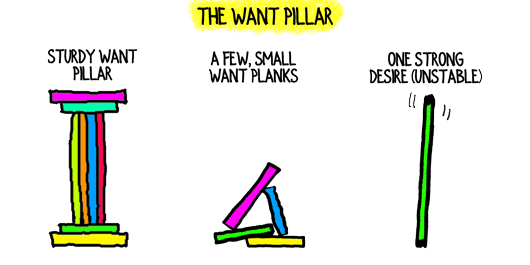
For instance, while a single, towering Want could catapult you to a closed project, if that lone desire fades or is satisfied elsewhere, your chances of winning the project evaporate.
Similarly, a pillar built from a haphazard agglomeration of small emotional planks rarely rises to the level necessary to win a consulting engagement.
In contrast, a well-balanced pillar that supports a sale is fashioned from multiple emotional planks, at least a few of which are large.
The 10 Most Common Emotional Planks
(Desires that Build the Want Pillar)
Relief
The desire to remove pains, problems, bottlenecks and threats.
Clarity
The yearning for knowledge of how to move from the current state to a desired state.
Reassurance
The confidence that current actions are justified, forward progress is possible, and future steps will succeed. (Also includes the bolstering of courage and self-worth.)
Security
The need for a sense of safety, control and defense against potential threats and costly mistakes.
Triumph
The drive for achievement, accomplishment, breakthrough and success. Triumph can also cover motives such as pride, greed and revenge.
Freedom
The unquenchable thirst for independence often manifests as dissatisfaction with restraints, restrictions, and oversight.
Serenity
The wish for fewer alarm bells, smoother operations, and less chaos. Can include contentment.
Validation
The hope to be proven right, to gain credibility, to impress others. Also includes the potential to shift blame if things go wrong.
Legacy
The drive to create lasting impact, be remembered, or shape the future in a meaningful way.
Connection
The desire for social contact, community, and human bonding.
Less common emotional planks include righteousness, inspiration, ease, and joy.

Stay acutely attuned to the ten common emotional planks during your discovery process with consulting prospects.
Direct questioning, subtle probing, and careful observation will reveal the number and size of emotional planks contributing to your potential client’s Want pillar.
If you detect few powerful feelings fueling your prospect’s desire to work with your consulting firm, the project probably won’t close. Move on to other opportunities.
What has your experience been with consulting prospects acting (or not acting) on emotion?

Text and images are © 2026 David A. Fields, all rights reserved.

Thanks Dave,
To be brutally honest with myself…. I don’t have a problem getting clients.
I do have a big problem retaining clients. I think my task focus is helpful as I get started in an assignment, but as I solve that issue, I think that clients may feel like they have had enough help, and they can “take it from here”.
I am on-site with a new (and ideal) client today, having signed about six weeks ago.
And I realize (after reading your article) that I may be too focused on the one or two emotional reasons he hired me. In fact, there are several other emotional components to this job where I can add value, and remove pain.
He hired me for Clarity and Validation. And now that I am on the job, I see that his other emotions which are equally strong are desires for Relief, Reassurance, Security, Serenity, and Legacy. In fact, now that I have written them down here, I can see that these are all very personal and very intertwined.
So glad I took the two+ minutes to read today’s article.
Thanks again.
(BTW – this is the same prospect, now client, I wrote about in December, who was ghosting me after initial positive interactions. The advice you gave helped me close this deal.)
Ken, first, congrats on winning the deal! Good on you for your persistence. Double good on you for applying the emotional “planks” to your current client situation.
You’re absolutely right that connecting with your clients’ emotional wins is integral to retaining them. Of course, you also do need to be able to solve ongoing challenges or help them toward their (ever changing) aspirations.
Thank you for providing the real world case study, Ken, and for being candid in your comment. Super valuable contribution to the discussion.
David: Excellent article, but I think there’s more to this “emotional” concept than is relevant only during the initial hiring phase. As a clinical and consulting psychologist I use emotion and Emotional Intelligence as cornerstones in not only getting, but keeping clients. At its core, consulting is about achieving “change” in some form or another, and to ignore the importance of emotion as a fundamental driver of any “change” would be a mistake. After all, as David says, relationships are the foundation of a consulting process, and are not all relationships the result of “emotional” investments?
You’re 100% right, Alan. While this particular article was focused on the Business Development process, the emotional wins play an important role throughout your engagement.
In fact, clients’ perception of a project’s value is only partially based on the results you deliver. The other part is the Client Experience, which revolves around their feelings.
Thank you for pointing that out, Alan!
My favorite one of your articles, mostly becuase this is what I do (leveraging these for brands). One thing I’ve noticed is that when clients can’t get the funds to work with me, they’re really disappointed, and say how much they wish they could. It’s like they’re grieving the loss of a future self they realize they won’t be able to meet. But like the commenter above, I do feel that once I’m in there and doing the project, selling future work doesn’t happen as easily. Maybe b/c their emotion was satisfied?
Interesting situation, Courtney. Yes, it’s possible that your clients are satisfied once you’ve performed your work and, therefore, there’s not the Want necessary to drive the follow-on project.
Winning follow-on work is the easiest source of revenue for many consulting firms; however, it definitely depends on the nature of your work. Also, setting up your projects to surface/encourage future work will make a big difference.
Thank you for your comment and the kind words about the article, Courtney. It means a lot coming from a pro like you!