
 David A. Fields Consulting Group
 Huckleberry (a.k.a. Huck), the Assistant Deputy Vice President of FruitSpread, Co. asks whether you can help him out of a jam.
“Yes I can,” you reply, already tasting a sweet new consulting project.
The discovery process with Huck is smooth, and you anticipate this will be a plum engagement.
You submit an irresistible proposal (which includes the seeds of future projects) and all that’s left is to seal the deal.
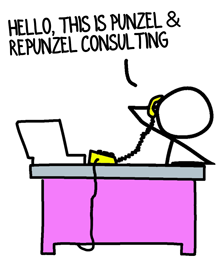
Surprisingly, Huck misses the call you scheduled to address any sticking points on the proposal. He also doesn’t respond to emails.
Finally, after two weeks of stewing over the situation, you reach Huck. He informs you, “I submitted the proposal to my boss, but she was canned. Now I’m waiting to find out who replaces her.”
Huck had to clear the proposal with his boss?
That’s an annoying twist, and you’re left with a pit in your stomach, knowing the fruit of your labors is frustration.
Every consultant has tales like this one—where a project seemed like a sure bet, only to find the person who claimed to be the decision maker couldn’t approve the initiative after all.
Grrrr.
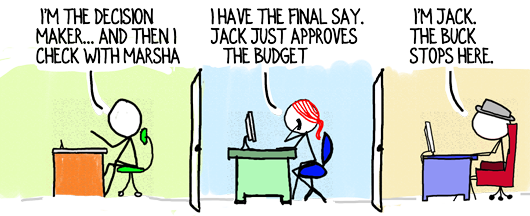
What’s the antidote to this sour situation?
Most consultants use one of the following approaches to identify the decision maker:
- Asking some version of, “Are you the decision maker?”
- Asking some version of, “Who’s the decision maker?”
- Asking some version of, “Who gives final budget approval?”
- Doing nothing and hoping it works out.
The most popular option is doing nothing. But, even when we ask one of the first three questions we’re often led astray.
The person we’re talking to says he’s the decision maker, only to reveal later that someone else’s approval is needed.
Huck isn’t being malicious. In his mind, he is the decision maker, or at least an important decision maker.
And he does have to approve the budget for the project to go forward… right before his boss also gives the project the nod.
What you need is some x-ray goggles that will penetrate your contact’s unwitting subterfuge.
A reliable divining rod that will point you to the true seat of power.
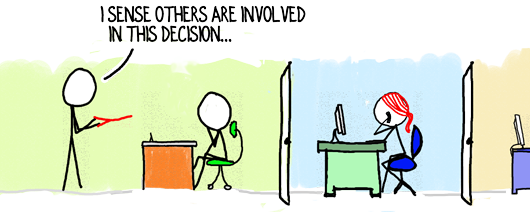
In fact, you were dang close to it before, and only a subtle change in your question will expose Huck for what he is: a fruity pretender, sweet-talking you despite having no budget authority.
The “Decision Story” Method
The Decision Story is a very trustworthy approach for identifying the final decision maker inside a new client.
It starts with the following question:
“What’s the process for deciding on this initiative and bringing a firm like us in?”
The most important word in that question is “process.”
Rather than asking Huck for a definitive answer (“who makes the decision?”), you’re asking him for a broad description of what will happen.
A story.
Huck’s tale offers the clues you need.
He can paint himself as the decision maker while indicating others are involved.
For instance, when he says, “We’ll have to look at the price, of course,” then you know to ask who “we” refers to.
If you suspect the decision maker may change depending on the size of the project, then ask Huck, “Does the process change if the budget for this is over $xxx?”
You’re still talking about the process.
For $xxx, substitute $10,000 or $50,000 or $100,000 or $250,000 or $1 million. Those are natural break points for signing authority.
Have you tried the Decision Story (or a variant) yourself? If so, has it proven fruitful for you?
Text and images are © 2026 David A. Fields, all rights reserved.

If the person we are talking to isn’t the decision maker, what can we do? Try to talk to the decision maker, and if so, how?
Exactly, Gwen. Talk to the decision-maker. How? Say, “This is super helpful. I’ll also need to talk with the decision-maker.”
If you need to support your statement, which generally you shouldn’t, there are a number of reasons why a conversation–even a very brief one–with the decision-maker is best for you, the person you’re talking with, and the project. Going into it is a bit outside the scope of a brief comment, though.
I’m glad you asked the question, Gwen!
CEO, “I’ll refer your project proposal to HR and wait for what they say about it.”
HR is where projects go to die.
You are so right, Patrick. By and large, if a project is diverted to HR, you’re in trouble!
Thanks for adding your perspective today!
Good reminder, David. Thanks.
And thank you for posting your reaction, Tara! Much appreciated.
I’ve found a method that usually works. Our business helps mid-market companies replace obsolete ERP. We start these projects with a pilot project with the C-Suite leadership team. We ask them what strategic goals need the new ERP to be achieved, who is responsible for achieving those goals, and what the system must deliver to achieve those goals.
There are 2 deliverables: a summary of what was discussed which we present to the CEO for signature. They can add anything they have thought of since the meeting, or correct any misunderstandings we have. We also present a proposal as an action plan that will deliver the results they want.
This takes the form of a 1-to 2-hour meeting, and we bill the client $7k to $15k for the service. This approach achieves the following:
1) We identify the real decision-makers. In a mid-market company, this is usually the CEO or CFO.
2) We build a relationship with the decision-maker (s)
3) We identify the value of the project to the client based on achieving strategic goals. (Forget about cost savings; the real consulting money is in helping a company achieve its strategic goals)
4) The client gets used to paying us. When the project starts, the ACH payment method will be in place and will not delay things.
5) If the client decides not to proceed, we will at least be paid for our discovery work.
6) Any CEO can approve a payment of $7k to $15k. If there isn’t a real project there, they won’t approve it, and we avoid wasting time on a phantom project.
The above describes WHAT we do; HOW we do it is a bit more in depth. But I can say ChatGPT saves a lot of time compared to the old way we did it.
Chris, thank you for sharing your comprehensive process in detail. You’re finding your way to the decision-maker through multiple paid steps, realizing that the decision-maker can change as the budget rises. I’m sure many other readers will benefit from your case study.
How far into the process are you before you ask to speak with the decision maker?
I’ve been on both sides of this equation, and if someone were to ask for the decision maker before we’re finished with the initial scope, I would be put off by the early ask.
As a facilities director in the past, I usually made it a moot point by telling my prospective vendor that I was sure it would be over my budget authority and that I would be submitting the proposal to a person or committee (depending on the facility).
On large projects, certain vendors asked, “If I’m the supplier you choose, I would like to present the proposal. Would that be satisfactory to you?”
I always felt the vendor who would make that request was one I’d like to work with. I liked the confidence that statement displayed.
I could not agree more. It was my job to reco the final supplier to my boss, and if they all start asking to speak to my boss, I’d stop engaging with them (back when I was in corporate). Now, when I engage with larger companies, it’s hardly ever the CEO who reaches out. So waiting for my contact to convince his global CEO that they really need to do this.
Courtney, as with my response to Don, you’re looking at consultants as “suppliers.” Yes, we are in the broad sense; however, most suppliers probably don’t have to talk with the boss. As a consultant working on a complex project for which the boss has expectations that s/he probably hasn’t communicated well to subordinates, a conversation is crucial. And if you need your contact to convince their boss to the project, you’re looking at a frustrating business development process!
Thanks for jumping into the conversation, Courtney, and adding your POV to Don’s. Super helpful.
Interesting question, Don, with a mindset shining through: you see consultants (or yourself?) as a “vendor.” I see consultants as, ideally, partners. Moreover, valuable partners that are not interchangeable with other folks offering similar services. I would never say, “If I’m the supplier you choose” because it’s totally outside the mindset of being a partner.
All of that said, ask for the decision story at the beginning of the process. If you’re not talking with the decision-maker, then you can walk through the Context with your initial contact while making it clear that you’ll also need to have at least some interaction with the decision-maker before submitting a proposal. If your contact refuses to let you talk with the decision-maker (i.e., they’re acting as a gatekeeper), then you can opt either to walk away or to accept that your odds of having scoped the project correctly are low, and your odds of winning the project have dropped precipitously.
I’m glad you brought up the situation to discuss, Don!