
 David A. Fields Consulting Group
 How many prospects should there be in your consulting firm’s target market?
The more the merrier, right?
Not really.
There’s a lower limit and an upper limit on your perfect target market size for your boutique consulting firm.
It’s sort of like Q’uma chocolate bars. Savoring one square from a 30% cinnamon bar leaves you crying for another taste. A thousand bars would bury you, and once you’d eaten enough to max out your bathroom scale, they’d lose their appeal.
You have to find the right balance. (A 12-bar case is perfect. Just sayin’.)
The same holds for the target market of your consulting firm.
Too few prospects will leave you hungry for more clients.
Too many prospects will make you unattractive. (More on that, in a moment.)
What’s the right balance for your consulting firm?
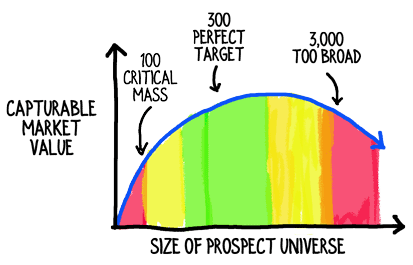
Roughly 300 prospects in your target market.
Three hundred prospects is perfect for a boutique consulting firm to build a $3M-$10M practice area.
That same number is also the right size for a solo practitioner to build a solid, $450K-$1M practice.
Of course, the dangers of too small a target market are obvious.
If there are only one or two chocolate bars in the box and someone else snatches them up, you’re out of chocolatey goodness.
While I’ve seen consulting firms build to $10M in annual revenue with only a handful of solid clients, and perhaps 20-50 contacts in their prospect list, that’s a risky long-term financial model.
The downsides of too large a target market are less obvious.
If you were running a large consulting firm or a mass-market consumer products company, you might want as large a market as possible.
But you’re not.
You’re running an independent consulting firm.
You’re Q’uma, not Hershey.
Highly successful boutique and solo consulting firms tend to have smaller target markets than their less-successful counterparts.
Once you get past the friends-and-family stage, clients engage your boutique consulting firm because you have deep experience solving their exact problem—usually you’re well versed in their industry and have implemented the solution many times.
Generic, broadly applicable frameworks and solutions have no value in a world where prospects initially turn to AI for answers.
If your target market definition expands too much, you look like a generalist and you become less attractive to new clients than competitors who specialize.
300. Got it. Now what?
First, take a hard look at the current definition of your consulting firm’s target prospect.
To help you complete this exercise, define your consulting firm’s prospects using two sets of attributes:
Attributes Defining Your Target Prospects
Qualifiers
(Your prospects must have all of these)
- Decision-maker
- Reachable (i.e., you could, with some work, engage in conversation)
- Experiences the problem you solve
- Wants to solve the problem
Descriptors
(These could describe your prospects)
- Industry and/or
- Function and/or
- Role/position and/or
- Situation
Does your definition create a pool of 30 or 300 or 3,000 or 30,000 prospects?
If it’s too broad, tighten the descriptive attributes or narrow the scope of the problem you solve.
Once you’ve created a definition of your target that leads you to a prospect universe of the right size, you can develop an efficient, effective visibility-building campaign.
What’s your guess on the number of prospects in your current target market?

Text and images are © 2026 David A. Fields, all rights reserved.
