
 David A. Fields Consulting Group
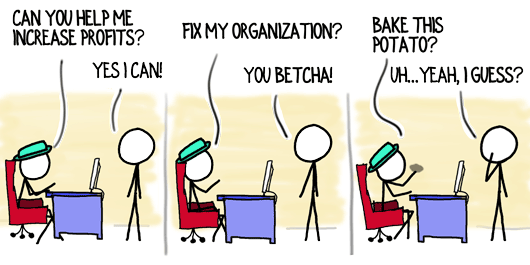
 If you ask for the most important phrase in consulting, a lot of consulting firm leaders will tell you it’s “Yes I can!”
The operative word being “Yes.”
At one point, I would have been in that camp too.
After all, your can-do attitude is your ticket to a successful consulting practice, right?
Wrong.
The most important word in consulting is simple:
You.
If you’ve read anything about Right-Side Up Thinking, you already know that consulting is a you business, not a me business.
Let’s move onto the second most important word in consulting. The one that separates the best boutique consulting firms from the rest.
Is it Yes?
As in, “Yes I can!” when a prospect asks whether you can help him?
Good guess. Fair answer. But, Yes is not the 2nd most important word.
I vaguely remember my kids bouncing through a phase where their favorite word was an emphatic, No!
They were smart, little rascals. It turns out toddlers have a worthy lesson to impart:
The value of your Yes is defined by the strength of your No.
As the leader of a consulting firm, you can accelerate your growth by learning to say No more and, as a result, narrowing your focus.
On the personal side, saying No more often to tasks you could handle leads to better individual effectiveness.
In the marketplace, saying No positions you as a specialist, which makes your consulting firm a more attractive choice to virtually every prospect.
The most successful boutique consulting firms deliberately promote a narrow area of expertise.
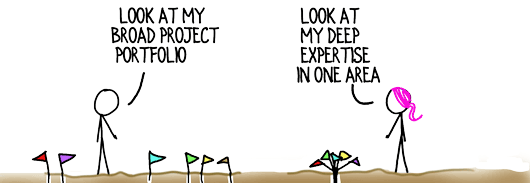
To find your Yes, you have to know your Nos.
Rather than emulating Johnny Appleseed, spreading possibilities everywhere, treat your consulting firm like a potato. Go deep, then spread out.
(Okay, potatoes may not be the best metaphor, but they’re amazing balls of flaky tastiness.)

Some Nos are easy. You don’t work on illegal projects, or dig trenches, or fry up a batch of curly fries, lightly sprinkled with salt and a dash of… no, you don’t do that.
On the other hand, the Nos right around the edges of your consulting practice are much harder to define.
Fuzzy edges lead to fuzzy positioning and fuzzy possibilities.
Therefore, those on-the-edge possibilities are the most important to clarify explicitly.
Tight edges bestow tight marketing propositions, confidence, and interested clients.
Spend a few minutes today defining your consulting firm’s Nos.
Below are a few thought-starter questions for you:
- What industries will you say No to?
- What style of buyers don’t fit?
- What types of projects fall outside your bailiwick?
- What size projects are too small?
- What geographies are out of bounds?
- What problems won’t you solve?
Your Nos are vitally important to hearing more Yeses from consulting clients.
What other ways do you define which projects you won’t say Yes to?
Text and images are © 2026 David A. Fields, all rights reserved.

Identifying the ICP (Ideal Customer Profile) and the focused pain that you solve, allows you to stand out as the SME (Subject Matter Expert). Excellent reminder, thank you!
Yes, Benny, knowing where your firm stands in the world is a big help if you want to grow your practice. Thanks for weighing in!
My opening gambit when someone says: “Can you do X?” is to say NO.
If you just say Yes, they zoom off as if they’ve delegated the task to you.
If you say NO, there’s an opportunity for dialogue.
Often, they’ve come up with a simple wrong way to approach X.
After I say NO, I can ask: “What are you trying to do?” which leads to clarity about the assignment and often a better solution.
That’s an interesting application of No, Jay. Generally speaking, anything that promotes more dialog and better understanding between you and your prospect is a good thing. Thanks for adding your insights!
Good article, David. I have found that sometimes “No” isn’t an actual “No.” Its something that occurs to us, an “aha” moment that comes after trial and error. My biz partner and I spent all last year blogging to our target customers in order to sell an information product for people they serve. When, in fact, we should have focused on providing training to them, with the info product as an included benefit. We are excited about our new approach and plan to launch in October. Wish us luck!
Excellent case study, Lauren. You’re right that No is often a step on the learning curve. Good on you for being willing and able to adapt, and good luck with the launch. Keep me apprised of the progress.
I would have guessed “responsiveness” for the second word! But I’ll happily take the lesson.
And it’s not a part of my practice, mostly ’cause it’s so easy: cold oil french fries. They’re not curly, but otherwise you’ll swear you got them fresh from a restaurant. Worth a Google as burger season approaches. Thank you as always David!
Great tip, Troy! Not a burger eater myself, but I’m sure other readers will appreciate the cold oil fries!