
 David A. Fields Consulting Group
 Value Isn’t the Real Issue Behind Every Consulting Fee Objection. This Is
Is there a single, underlying factor behind every objection to consulting fees? And, if so, is it one you can address?
There is, and you can.
The opportunity will become clearer when we separate push-back on the consulting fees from faux objections that are really clarifications of parameters.
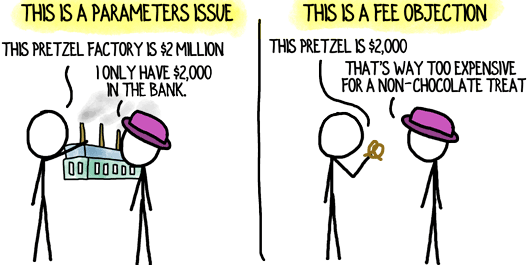
Your clients’ statements about budget limits, signing authority, and so forth are clarifying the parameters of your engagement.
They are simply a limit on the level of consulting fees that is allowable or feasible for your client.
Once you set aside clarifications, you’re left with honest-to-goodness dissatisfaction with your requested fees.
And your prospects’ real objection to your consulting fees boils down to the exact same underlying issue that drives every single complaint about pretty much everything:
Fairness.
When Cudby Client, CEO of PretzelSuite, reviews your proposal, she’s considering the ROI, and she’s also evaluating whether your fees are fair for the consulting work you’re proposing.
Fairness is all about comparison.
Comparisons to expectations or benchmarks or alternatives.
That’s why clients issue tightly written (though often misguided) RFPs.
It’s also why they ask for hourly rates and day rates—because those are concrete, easy-to-read measures clients can use to compare consultants to each other or internal staff or expectations.
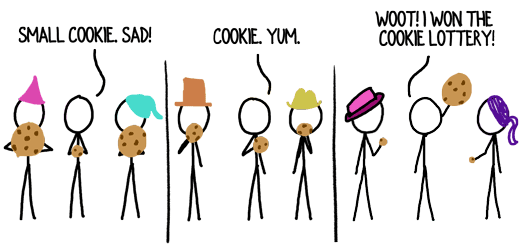
You win the fairness game—and overcome fee objections—by controlling the comparator.
When you determine the basis for your prospects’ comparisons and you directly call out the fairness issue, objections to your cookie consulting fees crumble away.
For instance, when you shift the discussion from fees-for-tasks to fees-for-outcomes, the client’s sense of what’s fair is reconsidered.
To make this even more tactical, next week I’ll share a script structure that builds on fairness to support premium fees.
Think of an instance when a prospect pushed back on your fees.
Was the underlying objection a fairness issue or a parameters clarification?

Text and images are © 2026 David A. Fields, all rights reserved.

I used to offer to work for 10% of what I could save a company using Quality Improvement methods and tools (i.e., Six Sigma).
No one would take me up on it.
I think every manager secretly knows that they are wasting 1/3rd of total revenues fixing stuff that shouldn’t be broken and trashing stuff that can’t be fixed.
No manager wants to be on the hook for writing a six-figure check for something they think they should be able to solve themselves. They would look incompetent.
I think many objections are just “don’t make me look stupid for not knowing how to do this myself.”
You’re absolutely right, Jay. One point on the Trust Triangle is “You won’t harm me.” If a decision-maker or a strong “breaker” thinks your project could hurt their reputation, they’ll come up with every excuse to say No to the engagement.
The percent-of-savings approach consistently runs into fairness issues. We have a client who was signed a deal like that and, by the letter of the contract, should have been awarded $10M. The Board of the company intervened after the work had been done and the savings had materialized. Even though the gains were real and their company benefitted grandly, the size of the payment galled them. They cut the payment by 30%. (Our client still made out pretty darn well—$7M isn’t a bad fee for a project.)
Thanks for adding your case study to the discussion, Jay.
This is so true! I work in the nonprofit sector and have found it very difficult for people to make the mindset shift away from looking at an hourly rate to a value-based fee. This is especially the case for NGOs who were primarily funded with federal funds, which often require disclosure of hourly rates for consultants due to federally specified rate caps. Even when the engagement was not funded with federal funds, their procurement rules required an hourly rate. I was lucky that in some cases the NGO would just make their own estimate based on my fee and scope, but I’m sure I missed out on other work because of this (which means I would have had to set an hourly rate way below what I bring in terms of value to be competitive). With clients who are on board with a fixed fee, I find they still try to come up with a list of deliverables to justify the fee in their minds- or have some artifact they can point to at the end. In my experience, the most compelling responses to the fairness question have been reminders of the inherent conflict of interest with hourly rates, and a reminder that a lower hourly rate may look good until you find out that they take much longer to complete the work and/or it may need revisions and adjustments- which you will pay more for.
All excellent points, Jessica. The government buys differently because they have an overarching requirement that doesn’t apply to most private-sector clients: the appearance of propriety. That requirement forces them to suboptimize value and outcomes. Private sector companies don’t need to prioritize propriety or fairness at all, yet they adopt public-sector approaches.
One of our clients recently issued an RFP and set up a rigid, government-like process in place, including a phase where all prospective vendors received all other vendors’ questions and answers. When I asked why they did this, they said it was to be “fair” to every vendor. “Why,” I asked, “do you care about being fair to vendors? You have one priority: get the best results!” To me, it’s crazy.
Thanks for adding your experience to the conversation, Jessica!