
 David A. Fields Consulting Group
 Let’s say your consulting firm wants to lasso a few new clients.
You wrangle up two strategies:
- Scour the landscape for companies whose number one, burning priority is to address the problem your consulting firm solves.
- Survey your current contacts to determine their number one burning priority, and steer your consulting firm to address that issue.
Those two approaches will give your consulting firm the highest chance of success, right?
Probably not.
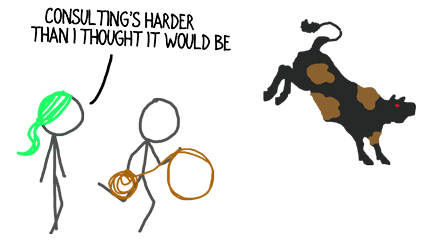
Both strategies focus on prospects’ highest priority issue, and that’s less fertile pasture than you’d imagine.
For instance, let’s say you’re targeting the Fortune 500 newcomer KneuralKnot, Inc. to enrich your portfolio of clients.
Intuitively, you know you’ll maximize your odds of winning a project at KneuralKnot by:
- Nurturing a relationship with Tim “Don’t Call me Red” Scarlett, the CEO;
- Solving Tim’s most pressing issue: how to scale thread count while avoiding recursive loops.
Alas, your intuition is leading you astray.
Tim’s subordinates are more likely to be decision-makers on consulting projects than he is and, in fact, their subordinates may be even more likely customers for your consulting offering.
When you’re chasing very large companies, aim for the middle. (See page 37 in this book.)
Further, in all likelihood, Tim is already riding herd on the thread counts problem.
In most cases, prospective clients are already in motion on their hottest issues.
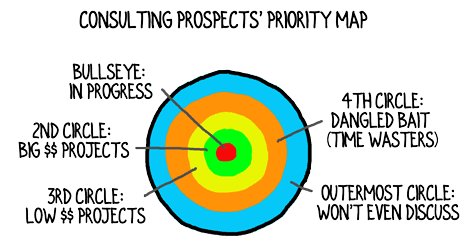
Yes, prospective clients who call you out of the blue may be motivated by their most pressing need. That’s true for your current clients too.
But when you’re focused on rustling up new clients, look for companies whose Second Circle priorities are the problem you solve.
Your proposition to Tim sounds something like, “Since we’re experts at weaving teams together, we can resolve the human-vs.-agentic engineering tangle you mentioned. That allows you to focus more on the scaling thread count.”
In other words, “Tim, if you let us work on the Second Circle, you’re more likely to hit the Bullseye.”
Of course, as you chat with prospects, you have to discover whether your consulting firm’s specialty fits in their Second Circle. Your question for prospects is:
“What are the high priority issues and challenges that you haven’t been able to tackle yet?”
Or, when inquiring about what’s going on in your prospects’ worlds, you can employ two of the most powerful words in a consultant’s vocabulary: “What else?”
If you tend to find yourself submitting proposals that never get signed, you may be chasing projects in the outer circles. Combat that time-sucking issue by asking prospects,
“In the grand scheme of things, how important is this project to you?”
Invest limited (or no) time and energy pursuing low-priority projects.
Historically, which type of project has been easier for you to win—Second Circle or Bullseye projects?

Text and images are © 2026 David A. Fields, all rights reserved.

Thank you, David, for these insights. As we all know, finding new clients in the consulting world is always a challenge.
It definitely can be, Tony. Fortunately, if you play the game well and take a long-term view, finding clients becomes notably easier over time. I appreciate your sharing your feedback, Tony.
Excellent insight. Everybody wants to work on priority 1, but often the route to lasting relationship is to run toward issues that are falling off the plate vs. piled right in the middle. Also, the “what else?” question is something that gets underused, especially in the face of a “no” from a client on a given scope. It has been a multi-million dollar question for our practice, but it rests on the presumption that the client likes working with you.
Fabulous contribution, Geoff. “What else” is, indeed, a massively powerful question in a wide range of situations. As you’ve pointed out, it’s particularly effective for moving beyond the obvious project to the winnable engagement. Most consultants would benefit from deploying that one simple question far more often.
Thank you for the excellent insight, Geoff!
Very interesting! Usually, so far I have found the bullseye issue is being handled by a much larger company or advisory company, while boutique firms handle the second circle and support roles. This changes the smaller the client becomes, where pricing becomes as much a factor as resources? What do you think?
Interesting thesis, Michael. While the size of the purse inevitably increases as the organization size grows, the relationship is far from linear. A $100M company may spend $500K on a consulting project, but a $10B company won’t spend $50M on the same project.
Price sensitivity has less to do with the size of the client’s company, and more to do with the culture and philosophy of the organization, the power and sophistication of the procurement department, and the nature of the engagement.
I’m glad you asked the question, Michael.
Interesting perspective David. Thinking back on both losses and on existing clients which terminated early, I can see how those “failures” were because the client perceived themselves as subject matter experts in the narrow subject they were trying to improve.
Instead, I might have been more successful, both at gaining and at retaining those clients had tried “flying a few thousand feet higher” occasionally to show them a perspective they could not see because they were so busy sticking-to-the-knitting.
I appreciate your serious discussion with brief and enjoyable format.
Very smart perspective on your own case studies, Ken. You’re right that it’s harder to satisfy clients when they view themselves as experts in the situation you’re addressing. (My firm faces this every day since consultants often think they are experts in the business of consulting, even if they’re actually experts in something else entirely!)
Excellent add to the conversation, Ken.
Nice one David. I never thought about it this way. I will give it a try. You always impress with your insights.
Excellent, Kumaran. Let me know how focusing on your client’s 2nd Circle priorities works for you and your team.