
 David A. Fields Consulting Group
 Without a doubt, the biggest hurdle most consulting firms face when they’re trying to win a project is the client’s inertia.
And also without a doubt, when you do overcome that inertia, your stiffest competition comes from internal staff (including, these days, the client’s favorite AI).
Why? Because our consulting prospects are like us: do-it-yourselfers.
Pay a plumber to fix that leak? Nah, the hardware store stocks everything you need.
Hire an attorney to write the will? Not when DontDieYet.com’s bot drafts one over morning cocoa.
Check into a hospital for an operation? Please… just shoot back to the hardware store for a box cutter!

Our consulting prospects sing a similar tune: “Why hire a consultant to improve our compensation plans? We’re smart enough to figure that out ourselves with a bit of help from Claude. Besides, we could hire two full-time employees for the fees you’re suggesting.”
Even if your prospect’s “lean-and-mean” staffing philosophy stretches their personnel past reasonable limits, internal personnel armed with the latest generation of AI still appear bargain priced compared to an outside guru.
How do you overcome the do-it-yourself barrier?
By changing your prospect’s perspective.
Below are four mind shifts you can employ to make your consulting firm the Obvious Choice.
4 Mind Shifts that Outwit the Competition (from DIY)
Shift their Path to Success
Internal resources and AI can easily tackle a series of simple tasks, particularly when a less-than-stellar output is acceptable.
If that’s the perceived path to success, you’re in trouble.
However, an astute, premium-priced consulting firm like yours is needed when the path involves sophisticated ideas and processes, and the quality must be excellent.
Does this imply you should portray your approach as complex and wrap it in abstruse language?
No, but you better bring more to the party than the ability to execute generic plans.
Reorient your prospect’s perspective on what’s needed by breaking out models, conceptual frameworks and approaches that show greater command of nuance than they’ll encounter using untrained staff with AI.
You can also tactfully point to the impact of sub-par outputs.
You must create clear, concept-level and consequences-level differences between you and internal choices.
Shift their Objective
Lift your prospect’s gaze from the weeds, where any resource is good enough, to the clouds, where outstanding, experienced (and expensive) know-how is required.
When a client is focused on a “deliverable,” such as a report or training session, they’ll look for the least expensive, easiest source of that deliverable.
However, a client seeking an outcome is wary of cheap, easy fixes and hallucinated solutions.
For instance, a training session on procurement is a deliverable and perhaps Sally from the Purchasing department can lead it.
Reducing material costs across all divisions, on the other hand, is an outcome and to achieve that end the client will pony up big dollars to a consulting firm that boasts strong credentials and tools.
Shift their Comparator
Prospects overweight cost when deciding whether to hire a consulting firm, because cost is concrete and easy to measure.
Unfortunately, prospects mistakenly evaluate the cost of consulting against compensation paid to employees. Surprise, surprise, the price-tag on a great consultant looks sky high next to an AI-wielding employee’s salary.
You know what doesn’t work? Arguing about the fully loaded cost of an employee or the “true costs” of AI.
You’ll enjoy better results with statements like this one:
“If your objective is to save money in the short term, then using your current staff or hiring a couple of folks is the way to go. However, if your objective is to bring the most expertise possible to bear on the problem at hand, then we’re the answer.”
Shifting the comparator to value or expertise positions you in a far more flattering light.
Shift their Scarce Resource
We all dole out our scarce resources jealously. Money, time, chocolate.
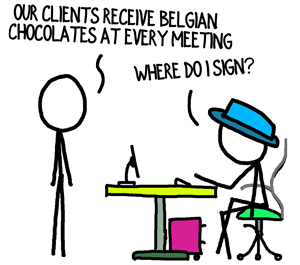
Clients are no exception, and they also face significant pressure to preserve funds by applying internal resources and the latest AI tools wherever possible.
How do you alter this viewpoint?
By highlighting a scarce resource more precious than money.
Time, expertise, experience, proven processes, momentum, and management support illustrate just a few examples of limited or fleeting resources.
For example, biotech companies will open their coffers to any consulting firm that can advance the launch of their products by a few weeks.
Yes, AI has collapsed many processes’ timelines from months to minutes. AI in the hands of experts holds even more promise.
When your prospect views you as the route to a resource more precious than money, competition from internal resources evaporates.
What have you changed to shift prospects’ do-it-yourself thinking and win vs. internal staff?

Text and images are © 2026 David A. Fields, all rights reserved.

What are the consequences of NOT hiring us?
How much longer will it take? Can you afford to wait?
Haven’t you waited long enough to start getting the results you want?
In Six Sigma, for example, companies often train Black Belts to train Green Belts to start teams which often takes months or years to get results. Meanwhile, leadership gets annoyed. Without results, Six Sigma efforts are often short lived.
A faster way is to train teams in day-long Minimum Viable Training (MVT) and immediately apply that knowledge to a specific problem they want to solve.
This creates instant expertise and screens team members for more advanced GB or BB training. I call this Agile Process Innovation.
Great example, Jay. A critical point is whether or not they are already in motion using internal resources and, despite that, not seeing progress or results. That makes shifting the conversation much easier.
Thanks for jumping in with your experience, Jay!
Fact of life: People who focus on price invariably pay more than people who focus on value. The more value you, as a consultant, can create for your client, the more you can charge for your services. To do this, you need to reframe what your client wants in terms of value as opposed to price. Remember, your client is the only person who can convert value to cash for you.