
 David A. Fields Consulting Group
 It’s the topic that everyone has on their mind, but is uncomfortable bringing up. The one you know will have to be raised at some point, and you’re shy about broaching it too early.
Male pattern baldness. Fees and pricing.
When is the right time to first broach fee or budget discussions with a prospective consulting client?
At the earliest, you could raise this sensitive subject before you ever meet a prospect or, at the latest, you could specify fees after you submit your proposal.
That’s a wide range of possibilities!
For this article, we’ll ignore two situations:
1) When the client’s strict contracting approach leaves you no choice on when to talk about budget or fees.
2) When your offering is productized and the pricing is publicly available.
Instead, we’ll focus on the typical, non-RFP, high-ticket, custom consulting project.
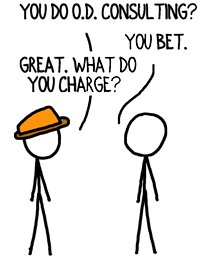
Clients frequently cut to the chase, inquiring about your pricing about 15 seconds after they’ve described what they want.
You’re probably slower to the punch.
As a consultant, you may be inclined to defer any mention of budgets, fees or pricing until after you’ve articulated every detail of your spectacularly compelling approach, and preemptively dismissed every major objection.
Once your prospect is swooning over your capabilities and credentials, he’ll pay whatever fees you suggest, right?
Uh, no.
When it comes to discussing fees, clients jump in too early and consultants often wait too late.
The ideal time to broach the topic of budgets and fees is before you dive deep into the benefits of working with your consulting firm, and before you outline possible solutions.
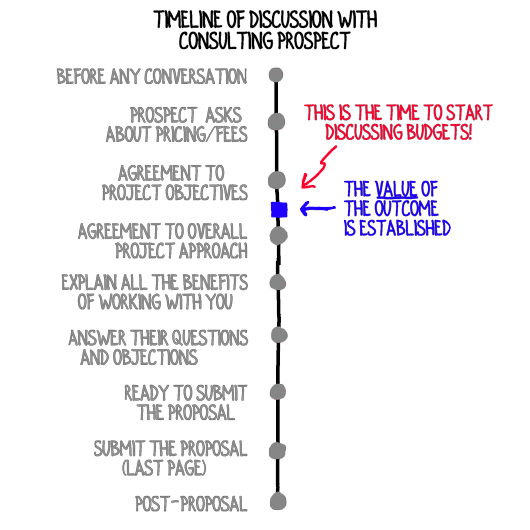
In other words, initiate conversation around your prospect’s budget once the prospect is fully, explicitly attuned to the value of solving their problem, and envisioning the rewards from a successful project.
Fees are not about the value of your services—they’re about the value of your prospect’s outcome!
You venture into the topic by leveraging the Parameters portion of the Context Discussion.
You can ask, “Are there any budget parameters?” and, “What were you anticipating the fees would be to achieve your outcome?” and the heart attack question.
If your prospect’s budget is out of line with the project they’re envisioning, you can course correct—long before you’ve spent hours discussing detailed approaches or developing a comprehensive proposal.
You don’t conclude the fee discussion right away, of course.
You’re in no position to determine your final fees yet; all you’ve done is started a discussion that you’ll continue later and conclude during post-proposal negotiations.
Later, during the negotiations phase, you will ease any remaining budget concerns and close your lucrative project. (Woohoo!)
When have you typically started talking about fees? What’s worked or failed for you?

Text and images are © 2026 David A. Fields, all rights reserved.

Absolutely love this sentence: “In other words, initiate conversation around your prospect’s budget once the prospect is fully, explicitly attuned to the value of solving their problem, and envisioning the rewards from a successful project.”
Thank you for sharing that, David! Powerful!
You’re so welcome, Bob. It’s easy to forget that we never actually “sell” a prospect anything. Clients buy because they envision a better future and tell themselves they can reach it with our help. Their internal dialog, not our words, seal the deal.
I truly appreciate your feedback, Bob.
Smart advice. When I’ve done this, it works and there’s not much negotiation
That’s excellent, Akash. Your validating the advice will give other consultants the courage to try it for themselves. Thank you for sharing!
Once I learned about the Context document, it changed my solo practitioner business. I utilize this practice with every prospective client. Not only does it weed out ones who are fishing themselves, it aligns the clients needs and desired outcomes. My clients appreciate this approach not only do they read it, they provide edits and input. Pricing then becomes a natural part of the process. It’s made my life easier and I’ve closed more business as a result.
Boom! Congratulations on your success, Molly. It’s the application of the ideas that makes them work, and you’re obviously applying them well.
I’m grateful that you’ve shared your story and experience with me and other readers.
In his 1970 essay “The Social Responsibility of Business Is to Increase Its Profits,” Milton Friedman argued that a corporation’s primary purpose is to serve its owners by using its resources to generate profit.
I think that is too narrow. The purpose of a corporation is to create value. Customers turn that value into cash, which the corporation uses to pay its employees, vendors, taxes, and finally, the owners. The more value the corporation creates, the higher the prices it can charge and the greater the profit for the owners.
Like “Beauty is in the eye of the beholder,” only customers can see the value in a product or service.
And ONLY customers can turn that value into cash. Thus, when a consultant aligns their value with a client, they can charge higher fees and generate greater profit.
In our ERP replacement consulting business, we meet with the CEO and CFO to identify which strategic goals are being blocked or impeded by the company’s current ERP and the 5-year value of achieving those goals. As a first approximation, 50% of the sum of those values is the ROI of a replacement ERP. Our fee is a percentage of that. The key here is that our fee depends on the value a new ERP system would create for the client and is based on the CLIENT’S numbers.
That’s a nice articulation of your value-focused approach, Chris. As you correctly point out, value is in the eye of the beholder, and our clients are the beholders. (As an aside, there’s an argument to be made that a corporation’s responsibility is also to “do good in the world,” not just to create value or reward shareholders—but that’s an entirely separate discussion.)
I appreciate your sharing your own experience on this topic, Chris!
I’m a fan of the question “if I was to say that the budget was $X. would you fall out of your chair?”, which I believe you taught me, David. It provides a bit of levity, while at the same time determining if you and the client are in the right ballpark to make continued discussions worthwhile. It also sets an anchor price-point for your services to commence negotiations. I smile when clients who initially declare that they don’t know their budget proceed to tell you exactly what their budget is once you’ve told them your “fall off your chair” number.
Very well done, Dave. And yes, that’s a variant of “The Heart Attack Question” that we teach. It’s very useful to receive direction from your prospect on the budget and to anchor them to a high price point. And, despite what some clients might think, both of those will result in a more valuable outcome for them.
I’m glad you shared your thinking and experience on this, Dave. You set a great example for others to follow on The Heart Attack Question.